

Hiring Manager vs Recruiter: Roles, Responsibilities, and Collaboration
Recruiters source and screen; hiring managers decide and onboard — the responsibilities, interview differences, and how they collaborate well.
Ployo Team
Ployo Editorial

TL;DR
- Recruiters: source, screen, schedule, and manage candidate experience.
- Hiring managers: define role, interview, decide, onboard.
- Recruiter interviews focus on screening and motivation.
- Hiring manager interviews focus on skill depth and team fit.
- Strong collaboration produces faster, better hiring than either role alone could.
"Recruiter" and "hiring manager" are often used interchangeably by candidates — and the confusion costs everyone time. The roles serve genuinely different functions in hiring, ask different questions, evaluate different things, and own different parts of the decision. Understanding the distinction helps candidates prepare better and helps companies coordinate hiring teams more effectively. This guide walks through what each role actually does, how their interviews differ, and what good collaboration between them looks like.
Who Does What in Hiring
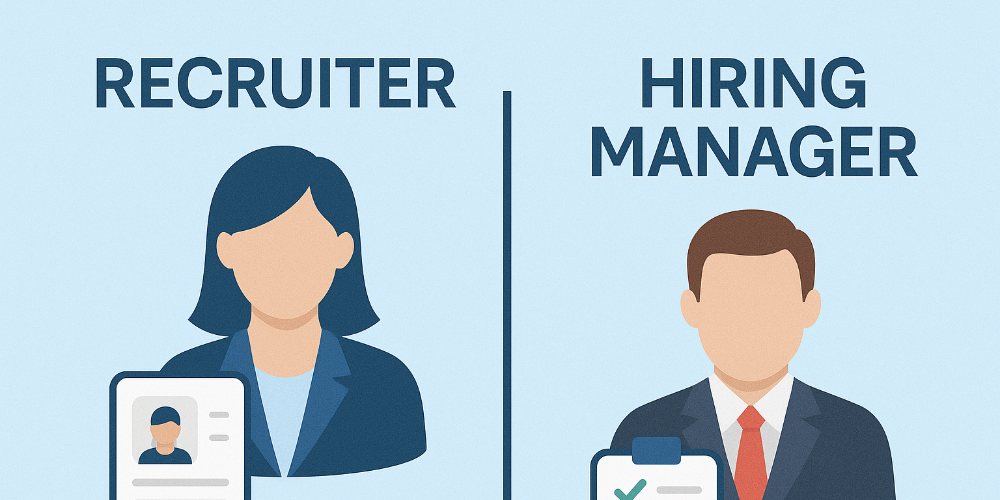
Both roles work toward the same goal — strong hires — but operate at different points in the process.
Recruiters are talent matchmakers
They find candidates, engage them, screen them, and present qualified shortlists. They own candidate experience from first contact through offer acceptance.
Hiring managers are decision-makers
They define what the role needs, evaluate shortlisted candidates against role criteria, and make the final call on who joins the team.
The handoff between them is where good hiring lives or dies. Strong collaboration produces consistent, fast outcomes; weak collaboration produces miscommunication, slow hiring, and bad fits.
What Recruiters Actually Do

Recruiters can be in-house, agency, or contract. Their work spans:
- Posting job openings — crafting listings to attract the right candidates
- Sourcing passive candidates — LinkedIn search, referrals, industry communities
- Resume review — first-pass screening against role criteria
- Phone screens — initial conversations to verify motivation, basic fit, salary alignment
- Shortlisting — selecting candidates strong enough to reach hiring manager
- Interview scheduling — coordinating across calendars, time zones, panels
- Offer presentation and negotiation — managing the close
- Candidate communication throughout — keeping people informed, engaged, respected
- Onboarding facilitation — handing off to internal teams smoothly
The thread connecting all of these: the recruiter is the candidate's primary point of contact through the entire process.
What Hiring Managers Actually Do
Hiring managers are typically the candidate's future manager — the person who will own their performance and development. Responsibilities include:
- Defining role requirements — what skills, experience, and behaviours the role actually needs
- Developing job descriptions — together with recruiters, accurately reflecting the work
- Reviewing shortlisted candidates — evaluating recruiter-presented candidates against role criteria
- Conducting deeper interviews — assessing skill depth, problem-solving, judgment, team fit
- Gathering team input — coordinating with panel interviewers and synthesising feedback
- Negotiating final offer terms — particularly around salary, role scope, growth expectations
- Making the hire decision — final accountability for who joins the team
- Onboarding the new hire — first-week ramp, ongoing 30/60/90 day coaching
- Tracking hiring outcomes — what worked, what didn't, how to improve
The hiring manager owns the result; the recruiter owns the process getting there.
The Critical Difference
Recruiters handle process; hiring managers own outcome.
When a hire goes wrong, the analysis splits between both:
- Was the wrong shortlist presented? Recruiter accountability — sourcing and screening criteria
- Was the right shortlist chosen badly from? Hiring manager accountability — evaluation and decision
Mature hiring teams treat the analysis as collaboration rather than blame. Both sides have learning to do; both sides improve through feedback.
Recruiter Interview vs Hiring Manager Interview

Candidates should prepare differently for each.
Recruiter interviews
Focus on motivation, basic fit, and screening. Typical questions:
- Why are you looking to leave your current role?
- Walk me through your career progression
- What's your salary range expectation?
- Are you legally authorised to work here?
- What other roles or companies are you considering?
- Why are you interested in this specific role?
Goal: filter for serious candidates and confirm baseline fit before investing hiring manager time.
Hiring manager interviews
Focus on skill depth, problem-solving, team fit, and judgement. Typical questions:
- Walk me through how you approached [specific work-relevant scenario]
- What does your day-to-day actually look like in your current role?
- Tell me about a challenging project — what made it hard?
- How would you handle [specific situation we encounter]?
- What questions do you have about the role, the team, or the work?
- Where do you see yourself in 3-5 years?
Goal: evaluate substance and fit at the level of actual work.
The candidate who prepares the same answers for both interviews underperforms. Tailoring matters.
How Recruiters and Hiring Managers Collaborate Well
Six practices that consistently produce strong collaboration.
1. Detailed intake meeting
30-60 minutes at the start of each role. Recruiter asks hiring manager about specific responsibilities, must-have skills, nice-to-haves, success criteria, deal-breakers. Vague intake produces vague shortlists.
2. Shared scorecard
Same criteria, same scoring rubric, same definitions. Eliminates the "you're not sending me the right candidates" friction that often comes from misaligned criteria.
3. Regular check-ins during search
Weekly 15-minute sync during active search. Calibrate on shortlist quality, adjust criteria if needed, address blockers.
4. Fast feedback after interviews
24-48 hours maximum. Hiring managers who let candidates linger lose them to competitors with faster cycles.
5. Modern tooling
ATS for candidate tracking, video for remote interviews, collaboration tools (Slack, Teams) for fast communication. Email-only collaboration is too slow for modern hiring.
6. Joint employer brand work
Recruiters define candidate-facing messaging; hiring managers contribute authentic team and role content. The combination produces stronger employer brand than either could create alone.
What Goes Wrong in Recruiter-Hiring Manager Relationships
Four anti-patterns worth naming.
Vague intake
"I'll know it when I see it" produces wandering searches and frustrated recruiters. Specific requirements upfront save weeks of back-and-forth.
Slow feedback after interviews
Hiring managers who take 2 weeks to provide interview feedback lose top candidates. Same-day or next-day feedback is the modern standard.
Recruiter-blame culture
When hires don't work out, the easy answer is "the recruiter didn't find the right person." Often the deeper answer is "the requirements weren't defined well enough." Both sides should review hiring outcomes together.
Insufficient hiring manager investment
Hiring managers who treat hiring as a side-activity produce predictably mediocre hires. Treating hiring as core responsibility — investing time in intake, interviews, and follow-up — produces dramatically better outcomes.
The Bottom Line
Recruiter and hiring manager are different jobs that work best when coordinated well. Recruiters own the process — finding, screening, scheduling, candidate experience. Hiring managers own the outcome — defining requirements, evaluating depth, making decisions, onboarding. Strong collaboration produces hiring that's both fast and high-quality. Weak collaboration produces the predictable friction that costs companies the candidates they should have hired. Candidates who understand the distinction prepare more effectively for each conversation; companies that coordinate roles well outhire competitors despite often similar budgets.
FAQs
Who has more power in the hiring process?
Different power over different decisions. Recruiters control who reaches the hiring manager (shortlist gatekeeping); hiring managers control who actually gets hired. Both roles matter; neither dominates entirely.
Should I send my resume to the hiring manager or the recruiter?
Standard process: through the recruiter or the application system. Direct outreach to hiring managers can work for senior or specialist roles but usually frustrates the formal process for standard openings.
Do recruiters make hiring decisions?
Generally no — they make shortlist decisions. The final hire decision typically rests with hiring managers and panel members. Recruiters influence outcomes through who they advance.
How should candidates prepare differently for each interview?
Recruiter screen: motivation, basic fit, role interest, salary expectations. Hiring manager interview: specific work examples, problem-solving approach, team fit indicators, growth questions. Different audiences need different preparation.
What's the highest-leverage improvement to recruiter-hiring manager collaboration?
The detailed intake meeting at the start of every search. 30-60 minutes upfront eliminates weeks of misaligned-criteria frustration later. Strong intake is the foundation everything else builds on.
Keep reading


Reverse Recruiters: What They Do and When They Actually Help
