

ML Engineer vs Software Engineer Salaries in 2026: Honest Comparison
ML engineers typically earn more than software engineers — but the gap is nuanced. The salary data, when SWEs match ML pay, and which path is growing faster.
Ployo Team
Ployo Editorial

TL;DR
- US average ML engineer total comp ~$202K vs software engineer ~$130-160K in 2025.
- ML talent scarcity, business impact, and FAANG bidding wars drive the premium.
- Senior SWEs and AI-hybrid SWEs can match or exceed ML pay, especially with equity.
- ML jobs growing fastest in WEF Future of Jobs 2025; SWE growing steadily ~17% through 2033.
- Career switchers from SWE to ML typically see substantial pay bumps.
The "do ML engineers make more than software engineers" question matters for career-stage developers deciding where to invest the next 2-5 years of their time. The short answer: yes, on average and consistently — but the gap is more nuanced than headlines suggest. Senior SWEs at FAANG-scale companies often match or exceed mid-level ML engineer pay; the AI-skill premium increasingly shows up across both tracks. This guide breaks down the 2025-2026 salary data, the structural reasons behind the gap, and the scenarios where the comparison shifts.
ML Engineer vs Software Engineer: The Roles

What ML engineers actually do
Build, train, and deploy machine learning models. The work spans data preparation, model design, training optimization, deployment infrastructure, and ongoing model monitoring. Strong ML engineers combine statistics, ML algorithms, software engineering, and increasingly MLOps infrastructure skills.
What software engineers actually do
Build scalable software systems — APIs, services, user interfaces, infrastructure, backend platforms. Strong SWEs combine algorithmic thinking, system design, language fluency, and increasingly some AI literacy.
Where they overlap
Hybrid roles like "software engineer, machine learning" and "ML platform engineer" demand both deep coding and ML systems knowledge. These hybrid roles increasingly command the strongest compensation as companies blend AI capabilities into core products.
Career path differences
- SWE progression: junior → mid → senior → staff/principal → engineering manager → director
- ML progression: junior → senior ML engineer → ML architect → AI/ML leader → AI VP
In AI-heavy organisations, ML progression often runs faster — the demand for technical depth outpaces the candidate supply.
2026 Salary Data
US averages
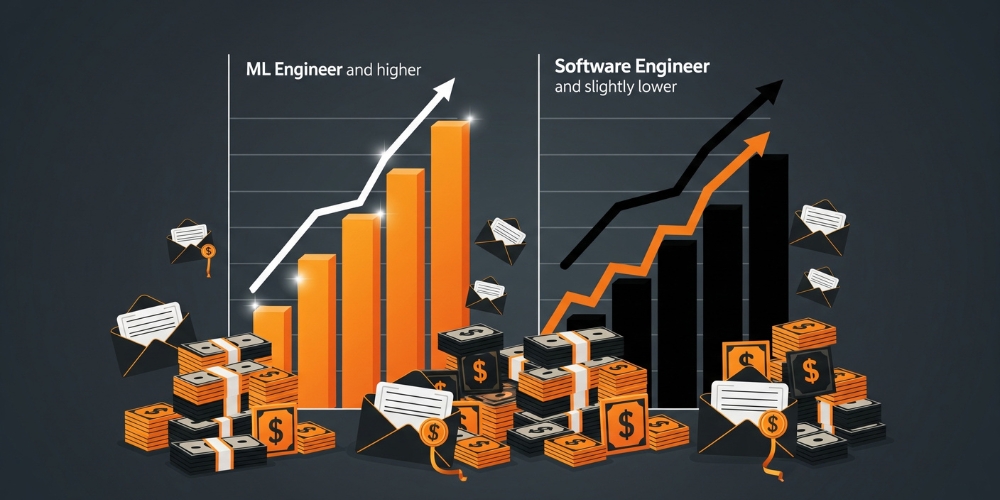
BuiltIn salary research shows US ML engineers average ~$158K base + ~$44K additional cash, totalling ~$202K.
Coursera SWE salary data puts the average software engineer base at ~$112K + $26-49K additional, total typically $130-160K.
By experience level
ML engineers:
- Entry-level (0-1 yr): ~$118K
- 2-3 yrs: ~$134K
- 4-6 yrs: ~$156K
- Senior: $180K-$250K+ base
Software engineers:
- Entry-level: ~$95-115K
- Mid-level (5 yrs): ~$120-173K
- Senior: ~$205K base
- Staff/Principal: $250K-$350K+ at FAANG-scale
FAANG-scale ML compensation
DataCamp ML salary research shows top-tier compensation:
- Google ML engineers: base ~$177K, total up to ~$281K
- Apple ML roles: base ~$193K, total up to ~$300K
- Meta ML positions: base ~$123K, total around ~$152K
FAANG-scale SWE compensation
Microsoft pay scale data shows senior SWE compensation regularly exceeds $300K, with elite positions at Meta or OpenAI reaching multimillion-dollar packages for top talent.
Why ML Engineers Are (Usually) Paid More

Five structural reasons drive the pay premium.
1. Scarce skill combination
Statistics + ML algorithms + software engineering + deployment infrastructure. Combining all four in one person is rare; rarity drives price.
2. Direct business impact
ML models often drive measurable revenue impact — recommendation systems, fraud detection, forecasting, automation. Companies see tangible ROI and pay accordingly.
3. Tech giant bidding wars
Meta, Google, Apple, Microsoft, OpenAI, Anthropic all competing intensely for ML talent. Elite ML researchers receive multimillion-dollar packages; mid-level engineers see secondary effects.
4. MLOps and platform roles
Hybrid roles requiring both software engineering and ML skills compound the scarcity — and the premium.
5. Faster career progression
In AI-heavy organisations, ML engineers advance faster than SWEs. The pay gap compounds with rank, widening over careers.
When Software Engineers Earn More

The pay gap isn't one-directional. Four scenarios where SWEs match or exceed ML pay.
Senior SWE at major tech companies
Microsoft pay data shows senior SWE base up to $284K. LinkedIn ML engineer total comp can reach $336K — but senior Microsoft SWE compensation often comes close.
Specialised infrastructure roles
Backbone systems, distributed databases, large-scale DevOps, security infrastructure — these specialist SWE roles sometimes pay at or above mid-tier ML engineer levels.
Equity-heavy packages
Senior SWE roles at scaled companies with strong equity programs frequently exceed ML compensation when stock vests over multi-year periods.
Staff/Principal/Engineering Manager paths
Senior SWEs who become staff engineers, principal engineers, or engineering managers often eclipse mid-level ML pay — particularly when leading AI-focused product areas.
Real comparison from Reddit r/cscareerquestions
"At Snap L5 SWE would be around 550k, then MLE would be at 580k."
A 30K gap at L5 at FAANG — real but not dramatic. The closer you get to staff-and-above SWE roles, the smaller the differential typically becomes.
Career Outlook Through 2026

ML engineering growth
365 Data Science research projects the global ML jobs sector reaching $113.1B in 2025, growing to $503.4B by 2030. The global ML engineer count grew by 219,000 in a single year recently.
WEF Future of Jobs 2025 identifies AI and ML specialists among the fastest-growing tech roles.
Software engineering outlook
Lemon.io SWE job market research shows 17% projected growth from 2023-2033, adding ~327,900 jobs. Growth concentrates on experienced SWEs and those with AI/ML fluency — entry-level hiring is slowing due to automation.
Where the convergence happens
Hybrid roles (ML platform, MLOps, AI-augmented SWE) are growing fastest because they capture the value of both paths. Pure entry-level SWE is most at risk; pure ML research is increasingly elite-track.
Career Strategy Based on Stage
Early career (0-3 years)
ML roles offer faster pay growth. Bootcamp graduates with strong ML foundations and one shipped project often start at $20-30K higher than equivalent pure-SWE candidates.
Mid-career (3-7 years)
Hybrid paths offer the strongest return. ML platform engineer, AI-augmented SWE, MLOps engineer — these roles capture the AI premium while leveraging existing SWE depth.
Senior career (7+ years)
The decision depends on what you want to optimise. Senior ML pays well but plateaus; senior SWE leadership tracks (staff, principal, EM, director) can exceed ML pay in companies with strong technical ladders.
The Bottom Line
ML engineers consistently earn more than software engineers on average — driven by scarcity, business impact, and intense competition for AI talent. But the gap is smaller and more conditional than headlines suggest. Senior SWEs at FAANG-scale companies often match or exceed ML pay; hybrid roles often top both; specialist infrastructure SWEs compete strongly. For career strategy: early-career developers benefit most from learning ML; mid-career developers benefit most from hybrid skill development; senior developers should optimise for the path that matches their strengths rather than chasing the pay premium alone. The future favours candidates who can do both well; the candidates who can't pick one direction often get squeezed in either.
FAQs
Is it harder to become an ML engineer than a software engineer?
Generally yes. ML requires the SWE foundation plus statistics, ML algorithms, data engineering, and deployment infrastructure knowledge. Many ML engineers started as SWEs and transitioned in.
Can software engineers transition to ML?
Absolutely — and many do. The transition typically requires strengthening math/statistics foundations, hands-on experience with ML frameworks (PyTorch, TensorFlow), and 2-3 real projects. Large tech companies often hire ML engineers internally from their SWE ranks.
Which role is better for remote work?
Both can be fully remote. Software engineering has a longer remote-work track record, but ML is catching up fast as cloud infrastructure makes remote ML work practical. For maximum remote flexibility, SWE still has a slight edge.
Do ML engineers always earn more than SWEs?
No. Senior SWEs at FAANG-scale companies, staff/principal engineers, and engineering managers often match or exceed mid-level ML engineer pay. The pay gap is real but conditional — not universal.
What's the highest-leverage skill to add in 2026?
For SWEs: production ML experience (model deployment, MLOps). For ML engineers: distributed systems and software architecture depth. The hybrid skill profile commands the strongest premium across both tracks.
Keep reading

Machine Learning Engineer Hiring Trends: 2025 Market Reality

