

AI Engineer vs ML Engineer: Salaries, Skills, and Career Paths in 2026
AI engineers vs ML engineers — the actual differences, current salary ranges, required skills, and how to choose between the two career paths in 2026.
Ployo Team
Ployo Editorial
TL;DR
- AI engineers build intelligent systems end-to-end; ML engineers build and scale the learning algorithms inside them.
- ML engineers tend to earn slightly higher base salaries; AI engineers see strong total compensation with growing premiums in generative AI and agent-based work.
- Both roles are in heavy demand across tech, finance, healthcare, and increasingly across non-tech industries.
- The choice between the two paths depends on whether you prefer algorithmic depth or system-level integration.
- Hybrid roles like "data science AI engineer" are growing fast as the lines blur in practice.
The titles "AI engineer" and "ML engineer" get used interchangeably in casual conversation, but they describe meaningfully different work. The rise of generative AI, LLMs, and autonomous agents has pushed companies to refine their distinction — and to pay differently for each. This guide walks through what each role actually does, 2026 salary benchmarks, the skill stacks expected of each, and how to choose between them based on your strengths and goals.
The Real Difference Between AI Engineer and ML Engineer
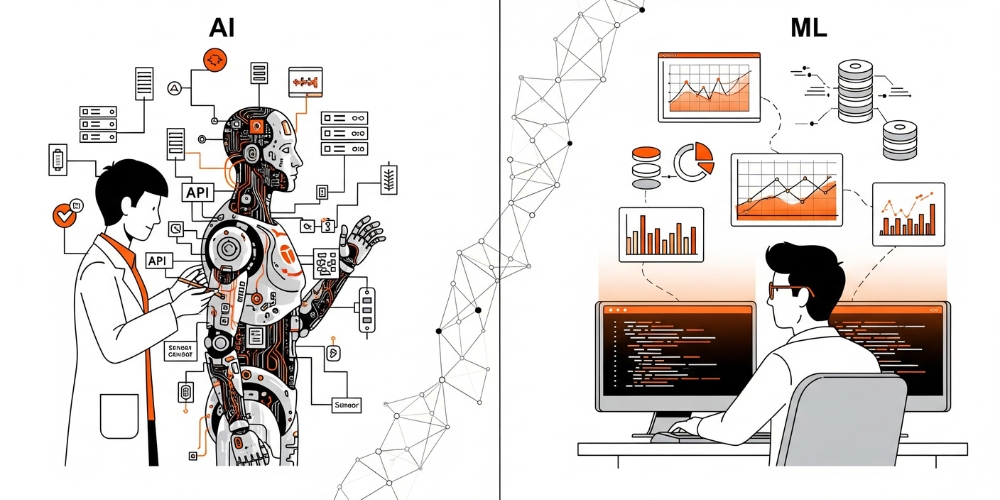
Both roles work in the AI ecosystem, but they focus on different layers.
| Role | Primary Focus | Typical Deliverables |
|---|---|---|
| ML Engineer | Designs, builds, and scales learning models | Classification and regression models, training pipelines, MLOps infrastructure |
| AI Engineer | Builds full intelligent systems integrating multiple ML components | Chatbots, recommendation engines, RAG pipelines, agent systems |
The useful mental model: ML engineers are like chefs perfecting recipes (models); AI engineers are like restaurant managers building the whole experience around those recipes. Both are necessary; both are increasingly specialised.
Core responsibilities side by side
| Task | AI Engineer | ML Engineer |
|---|---|---|
| Model selection | Yes | Yes |
| Data preprocessing | Yes | Yes |
| Model training and tuning | Yes | Primary focus |
| Production deployment | Primary focus | Yes |
| System integration | Primary focus | Rarely |
| Reinforcement learning | Yes | Limited |
| Robotics or IoT interaction | Yes | Rare |
Companies increasingly treat these as separate hiring profiles. Enterprise employers like Meta, NVIDIA, and OpenAI post separate job descriptions. Smaller startups often hire under a combined "AI/ML engineer" title, which works at smaller scale but tends to fragment as the team grows.
Two specific titles worth knowing:
- AI Specialist vs AI Engineer — "AI Specialist" usually signals domain-specific expertise (NLP, ethics, computer vision); "AI Engineer" implies a broader implementation role.
- Data Science AI Engineer — a hybrid title combining AI engineering with statistical analysis and experimentation, especially common in startups.
2026 Salary Benchmarks: AI Engineer vs ML Engineer
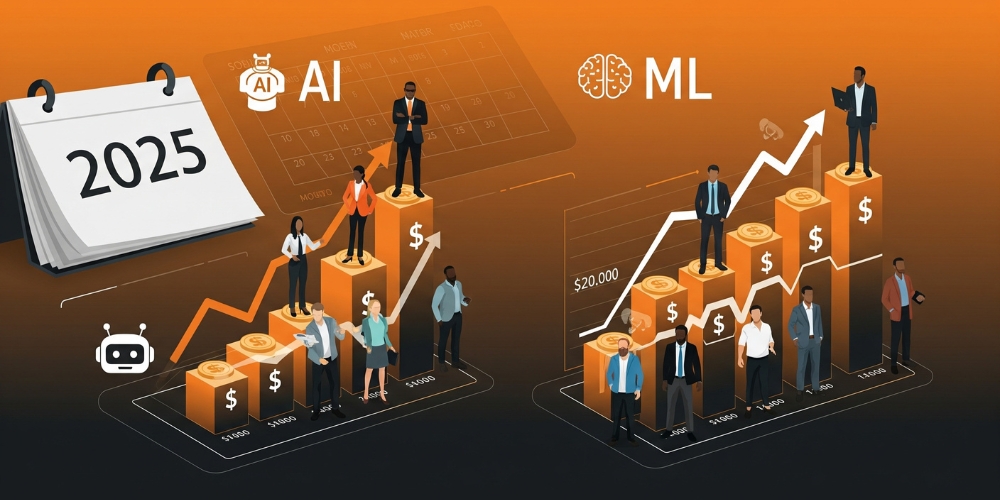
Both roles sit at the top of the technical compensation ladder. The detailed breakdown for 2026 across AI and ML engineer salaries in the US shows that AI engineers tend toward higher total compensation in product-centric roles, while ML engineers command premiums in data-heavy enterprise and research environments.
2026 salary ranges (US, base only)
| Category | AI Engineer | ML Engineer |
|---|---|---|
| National median base | $134,023 – $145,080 | $149,136 – $159,000 |
| Mid-level range | $149,923 – $192,884 | $149,136 – $192,044 |
| Senior-level range | $155,862 – $203,103 | $168,076 – $220,560 |
| Tech hub (e.g., San Jose) | $206,706 | $187,000 – $260,000+ |
| Remote average | $180,173 | $195,475 – $237,829 |
Total compensation regularly runs significantly higher once bonuses, equity, and profit-sharing are included — especially at AI-first companies.
Earnings by experience level
- 0-1 years (entry): AI engineers start around $103,015; ML engineers average $128,769
- 1-3 years (junior/mid): AI roles jump to $121,513; ML roles cluster around $134k-$142k
- 4-9 years (mid/senior): AI engineers earn $138k-$155k; specialised ML engineers can reach $190k
- 10-15+ years (expert): AI experts reach $185,709+; senior ML engineers in tech hubs exceed $220,000 base
Where the premium lives
Remote ML engineering roles are seeing a real premium — averaging close to $198,000 — because companies will pay significantly for talent that can build scalable infrastructure from anywhere. These roles also demand strong communication skills bridging deployment with business strategy.
The sharpest base-salary growth is in generative AI and agent-based systems. Specialised AI engineers in these niches see base ranges of $175,000-$250,000 as companies race to deploy autonomous agents.
Required Skills and Tech Stack for Each Role
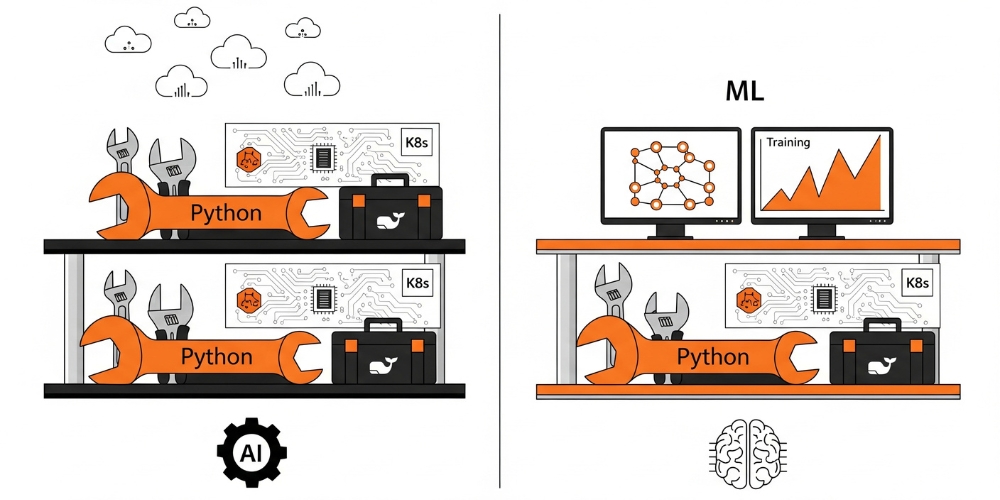
The 2026 distinction has shifted from "what they build" to "how they build it." ML engineers architect algorithmic performance; AI engineers integrate models into functional applications.
AI Engineer skill stack
A modern AI engineer is essentially a full-stack intelligence specialist. They orchestrate models into systems.
- Generative AI frameworks. Mastery of LangChain, Hugging Face Transformers, and LlamaIndex. These enable Retrieval-Augmented Generation (RAG) pipelines connecting LLMs to real-time data.
- Vector databases and retrieval. Embedding management through Pinecone, Weaviate, Chroma, or Milvus.
- Prompt engineering and fine-tuning. High-performance prompting and fine-tuning of foundation models like Llama 3 or GPT-4 variants.
- Cloud and containerization. Azure (~33% of roles) and AWS (~26%) dominate; Kubernetes and Docker are foundational.
- Programming languages. Python is dominant; Java remains heavily used (~22% of postings) in enterprise systems.
ML Engineer skill stack
The ML engineer focuses on algorithmic excellence and operational scalability.
- Model building and tuning. Deep expertise in PyTorch, TensorFlow, scikit-learn — training and hyperparameter optimisation.
- MLOps and orchestration. Kubeflow, Metaflow, Ray, or Flyte for model lifecycle management.
- Data pipelines. Spark, Airflow, or similar for preprocessing and feature engineering at scale.
- Deployment platforms. SageMaker, Vertex AI, or Azure ML — production deployment is baseline expectation.
Ethics and governance — the new "must-have"
Regardless of title, 2026 employers are hunting for engineers who understand data governance, ethical AI practices, bias mitigation, and privacy protocols. Demonstrating that you can build LLM systems that handle sensitive data responsibly is differentiating.
2026 core competency comparison
| Competency Area | AI Engineer | ML Engineer |
|---|---|---|
| Core technical | Python, Java, AWS/Azure, SQL | Python, SQL, C++, cloud ML platforms |
| AI specialisation | LangChain, RAG, prompt eng., NLP, CV | Deep learning, reinforcement learning, foundation models |
| MLOps | Vector DBs, Docker | Kubeflow, Ray, feature stores, CI/CD |
| Cross-disciplinary | Product thinking, UI integration | Statistical analysis, scalability, ethics |
In "Data Science AI Engineer" job descriptions, you will see a deliberate blend — statistical analysis on the data side, RAG-pipeline integration on the AI side, sometimes in the same week.
Which Career Path Fits You

The choice comes down to strengths, interests, and long-term goals.
Choose ML Engineering if you
- Prefer working deeply with algorithms, model architecture, hyperparameter tuning, and statistical optimisation
- Want a focused contribution profile — your impact is clearly measurable in model performance
- Enjoy collaboration with data scientists to refine and operationalise models
- Value the framework-driven craft of PyTorch, TensorFlow, scikit-learn
If you are leaning ML, our machine learning recruitment guide covers the broader hiring patterns in this space.
Choose AI Engineering if you
- Enjoy designing and shipping complete intelligent systems
- Want to work across NLP, computer vision, robotics, or agent-based systems
- Like working across cloud, DevOps, containerisation, and application integration
- Prefer real-world user impact over pure accuracy optimisation
Key considerations for the decision
Demand and career trajectory. Mondo's research shows roughly 1 in 4 US tech job listings now require AI or ML skills. Top-tier AI roles, particularly at hedge funds and elite tech firms, often command million-dollar packages for the strongest candidates.
Skills synergy. Research on skill complementarity finds that combining technical and soft skills lifts wage premiums by around 21%. The hybrid candidate consistently outperforms the pure specialist on total compensation.
Lifestyle differences. AI engineering roles tend to be more cross-functional — business stakeholders, design partners, UX teams. ML engineering can be more technically focused, particularly in research-leaning environments.
Practical next steps
- Build portfolio work that fits the path. Model-focused projects for ML; integrated AI + UI for AI engineering.
- Pursue internships or open-source contributions. Vector databases, LLM integration, model inference pipelines all bridge the two specialisations.
- Lean into skills-based credentials. Hiring increasingly weighs demonstrated ability over formal degrees, especially in ML.
The Bottom Line
AI engineer and ML engineer are no longer interchangeable titles. ML engineering is the right path if algorithmic depth excites you and modeling is what you want to spend your career mastering. AI engineering is the right path if you want to build user-facing intelligent systems and operate across the full stack. Both pay extremely well in 2026, both are growing fast, and both will continue to specialise as the industry matures. Pick the path that fits your strengths, build real portfolio work, and stay adaptive — the field will look different again in 18 months.
FAQs
Is AI engineering or ML engineering more in demand in 2026?
Both are heavily in demand. AI engineering with generative AI and agent specialisations is currently the fastest-growing niche; ML engineering retains strong demand across data-heavy industries.
Which role pays more?
ML engineering edges ahead on base salaries; AI engineering often pulls ahead on total compensation when generative AI specialisation is involved. The gap between the two has narrowed.
Can someone be both an AI engineer and an ML engineer?
Yes — many candidates do, especially in smaller companies or hybrid "Data Science AI Engineer" roles. The combination is increasingly valuable as companies look for engineers who can both build models and integrate them.
Do I need a PhD to break into these roles?
Not for most positions. Strong portfolio work and skill demonstration consistently outweigh formal credentials, except in research-heavy roles at top labs.
What is the single most important skill for either path in 2026?
For AI engineering: RAG pipeline implementation and LLM integration. For ML engineering: MLOps orchestration at production scale. Both signal you can ship work, not just understand it.
Keep reading

The Rise of the AI Engineer: Why the Role Became Mission-Critical

Machine Learning Engineer Hiring Trends: 2025 Market Reality
