

Hiring Through Saudi Recruitment Agencies: Challenges and Fixes
Recruitment agencies in Saudi Arabia speed up hiring — but bring real risks around Saudization, fees, and vetting. How to work with them effectively.
Ployo Team
Ployo Editorial

TL;DR
- Saudi private sector employs around 10.7M people; about 70% are non-Saudis as of 2024.
- Vision 2030 has tightened Saudization quotas — non-compliance creates real exposure.
- Common agency issues: unclear fees, weak vetting, limited Saudization expertise, slow response.
- Strong agencies have industry specialisation, transparent pricing, and active Saudi talent pools.
- AI-driven platforms increasingly outperform traditional agencies on speed and consistency.
The Saudi labour market is in transition. Vision 2030, Saudization quotas, sector-specific localisation requirements, and rapid private-sector growth combine to make hiring complex. Recruitment agencies promise to navigate this complexity — and many do, but not all. This guide walks through why employers use agencies in Saudi Arabia, the specific challenges that recur with weaker agencies, and how to evaluate partners so you get the hiring outcomes you actually need.
Why Employers Use Saudi Recruitment Agencies

Five common reasons employers partner with agencies in the Kingdom.
Time savings on sourcing and screening
Agencies handle the high-volume work — posting jobs, screening resumes, scheduling interviews — that internal teams can't always absorb at speed.
Access to passive talent
Strong agencies maintain candidate pools that don't show up on public job boards. For senior or niche roles, this is often the only practical access path.
Legal and visa navigation
Saudi visa regulations, KSA business visa procedures, and work permit processes are complex. Agencies that handle these well save substantial internal compliance time.
Saudization compliance support
Arab News labour data shows Saudi private sector employed ~10.7M people in 2024 with ~70% non-Saudis. Vision 2030 has accelerated Saudization quotas, particularly in finance, retail, healthcare, and engineering — agencies with active Saudi talent pools become essential.
Sector-specific market insight
Strong agencies bring real intelligence on salary ranges, candidate availability, and hiring trends. Especially valuable in Riyadh where market dynamics shift quickly.
The Real Challenges Employers Face

Eight failure modes that recur with weaker agencies.
1. Misaligned expectations
The agency doesn't fully understand the role and sends mismatched candidates. The result: wasted interview cycles, drawn-out hiring, frustrated managers.
2. Unclear fees and hidden costs
Quoted as a flat placement fee, then visa processing, onboarding, and add-on charges appear after the engagement starts. Refund and replacement policies are often vague.
3. Lack of industry specialisation
Generalist agencies struggle with niche roles. A tech company doesn't need a hospitality-focused agency feeding them generic resumes.
4. Poor candidate vetting
Resumes look strong; candidates struggle in interviews. Often the agency screened by phone and forwarded without real assessment.
5. Limited Saudization expertise
Agencies that don't maintain active Saudi talent pools can't meaningfully support Saudization compliance. Companies risk fines and operational restrictions.
6. Communication gaps post-placement
The "drop and go" pattern — the agency disappears after the candidate is placed. No onboarding support, no early-tenure check-ins, no replacement support when things go wrong.
7. Slow response times
Critical roles need fast shortlists. Agencies that take weeks lose top candidates to competitors who moved faster.
8. Weak background verification
Without rigorous verification, employers risk hires with embellished credentials or undisclosed legal issues. Especially relevant for expat candidates whose background data is harder to verify.
How to Work With Saudi Agencies Effectively
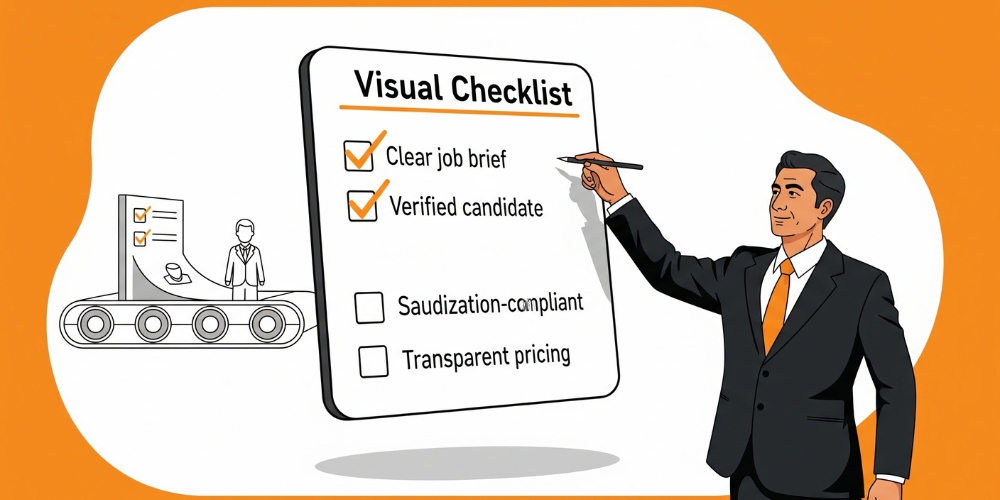
Six practices that consistently distinguish productive agency relationships.
1. Lead with a clear hiring brief
Before engaging an agency, document must-have skills, salary range, culture fit indicators, Saudization preferences, timeline, and visa requirements. Vague briefs produce vague candidate slates.
2. Demand industry-specific experience
Ask for case studies, recent placements in your sector, and client references. Strong agencies show their track record without hesitation.
3. Lock down pricing and SLAs in writing
Total fee, what it includes, replacement policy, time-to-shortlist commitment, screening process. Verbal commitments evaporate; written ones don't.
4. Verify Saudization capability
Ask specifically how the agency maintains Saudi talent pools, what sector-specific quota expertise they bring, and how they've helped clients meet Riyadh enforcement standards.
5. Audit the screening process
What specifically does the agency do before sending a CV? Real assessment, structured interviews, language verification, behavioural evaluation? Or just a phone call and forward?
6. Build feedback loops
After each candidate slate, give the agency structured feedback on fit. Strong agencies use the feedback to improve subsequent slates; weak ones keep sending the same misalignment.
Questions Worth Asking Before Hiring an Agency

Seven questions that reveal agency quality.
- "Do you specialise in my industry?" — Tests genuine sector expertise vs generalist filler
- "What's your Saudization capability?" — Tests whether they have active Saudi talent pools
- "Walk me through your screening process step-by-step" — Tests whether vetting is real or theatrical
- "What's your post-hire guarantee?" — Tests whether they stand behind placements
- "How do you handle visa and work-permit processes for expats?" — Tests legal and operational knowledge
- "What's included in your fee?" — Tests pricing transparency
- "What are market salary benchmarks in Riyadh for this role?" — Tests market intelligence
If answers to any of these are vague or rehearsed, that's signal worth taking seriously.
Market Context Worth Knowing
A few benchmarks that inform decision-making:
- Entry-level engineers in Riyadh typically earn SAR 8,000-10,000/month
- Cost-of-living benchmarks show ~SAR 4,500/month for a single person in Riyadh
- Saudization quotas vary significantly by sector — finance, retail, healthcare, and engineering face the strictest requirements
- MHRSD (Ministry of Human Resources and Social Development) enforces non-compliance with fines, visa delays, and operational restrictions
Understanding these helps you frame compensation, navigate localisation requirements, and evaluate agency claims realistically.
How AI-Driven Hiring Platforms Compare
Modern AI hiring platforms are increasingly competitive with traditional agencies on several dimensions:
| Dimension | Traditional agency | AI-driven platform |
|---|---|---|
| Time to first shortlist | Days to weeks | Hours |
| Pricing transparency | Often opaque | Typically flat-rate |
| Candidate vetting consistency | Variable by recruiter | Algorithmic + reviewable |
| Saudization filtering | Manual | Automated tagging |
| Scaling capacity | Limited by team size | High |
| Sector specialisation | Strong in narrow niches | Broad across sectors |
| Relationship depth | High for retained partners | Lower than dedicated agency |
The honest read: AI platforms outperform on speed, transparency, and scale; strong specialist agencies still outperform on senior or hard-to-fill roles where deep relationship work matters. Many companies use both — AI for volume hires, agencies for executive search.
The Bottom Line
Recruitment agencies in Saudi Arabia can dramatically accelerate hiring when chosen well — and dramatically waste budget when chosen poorly. The difference between productive agency relationships and frustrating ones is mostly upstream: clear briefs, sector-specific selection, transparent pricing, real Saudization capability, rigorous screening, and structured feedback loops. The companies that work with agencies effectively get the speed and reach they need; the companies that don't tend to blame agencies for outcomes their own briefing didn't make possible. With Vision 2030 raising the stakes on Saudization compliance, choosing the right hiring partner — whether traditional agency or AI-driven platform — matters more than it ever has.
FAQs
Are recruitment agency fees regulated in Saudi Arabia?
To a degree. The MHRSD licenses agencies and prohibits charging candidates for placement, but employer fees are not centrally fixed. Always negotiate fees in writing — verbal pricing creates disputes.
Do Saudi recruitment agencies help with Saudization?
Some specialise in it; many don't. Strong agencies maintain active Saudi talent pools and stay current on sector-specific quotas. Verify capability before engaging — Saudization support is a meaningful filter.
How do I choose the right agency for my sector?
Ask for case studies and references specifically in your industry. Strong agencies usually specialise rather than trying to serve every sector. For Riyadh-specific roles, prioritise agencies with proven local market intelligence.
Can agencies hire expat candidates legally?
Yes, through licensed channels. Hiring must follow Saudi labour law and proper visa procedures — KSA business visas don't substitute for work visas in most cases. The agency should walk you through the legal pathway, not skip past it.
Is an AI hiring platform a real alternative to traditional agencies?
For many hire types, yes — particularly volume hiring, role categories with established assessment criteria, and Saudization-tagged candidate pools. For executive search and deeply niche roles, specialist agencies often still outperform. Many companies use both depending on the role.


