

Candidate Sourcing Channels: How to Pick the Right Ones for Each Role
Matching sourcing channels to role profiles improves quality and cuts cost — the channel types, when each fits, and how to measure what actually works.
Ployo Team
Ployo Editorial

TL;DR
- Sourced candidates are ~5x more likely to be hired than inbound applicants (Gem benchmarks).
- 67%+ of recruiters now use social media to source talent.
- 92% of organisations use social platforms in their candidate sourcing mix.
- The right channel mix balances volume, cost, speed, and role fit.
- Track source-of-hire, cost-per-hire, time-to-fill, and quality-of-hire by channel quarterly.
Recruiters spending budget evenly across every sourcing channel are quietly losing on cost-per-hire while top candidates slip past them. Sourcing channels are not interchangeable — each one performs dramatically differently depending on the role profile, urgency, and budget. The companies that source well make deliberate choices: junior roles through job boards and referrals, senior specialist hires through direct outreach, hard-to-fill technical hires through niche communities. This guide walks through the channel types, when each one fits, and how to measure which channels are genuinely working for your hiring.
What Candidate Sourcing Channels Are

Candidate sourcing channels are the platforms, networks, and outreach methods you use to find and attract candidates. Each channel reaches a different audience — active job seekers, passive professionals, specialist communities — and produces a different mix of candidate quality, volume, cost, and speed.
The most common channels:
- General job boards (Indeed, Glassdoor, LinkedIn Jobs)
- Professional networks and social media
- Employee referrals
- Recruitment agencies and external sourcing firms
- Internal talent databases and silver-medal candidates
- Offline events (job fairs, campus visits, conferences)
- Direct outreach to passive candidates
- Niche industry forums and specialist communities
Combining the right ones is what produces a strong talent sourcing platform mix — not a buffet of "post everywhere and hope."
Why Choosing the Right Channels Matters

Five operational reasons channel choice matters.
Cost efficiency
Some channels (agency placements, paid job ads) cost significantly more than others (referrals, internal database). Spending should follow ROI, not habit.
Quality vs volume
Gem's 2025 recruiting benchmarks show outbound sourced candidates are ~5x more likely to be hired than inbound applicants. Volume from poor-fit channels produces fatigue, not hires.
Speed
The right channel for a given role can compress time-to-hire from weeks to days. The wrong channel can extend it indefinitely.
Role fit
What works for a junior support role often doesn't work for a senior specialist. Channel selection must match the role profile.
Scalability
You need channels you can rely on repeatedly. A one-off success doesn't compound; a reliable channel does.
Types of Sourcing Channels
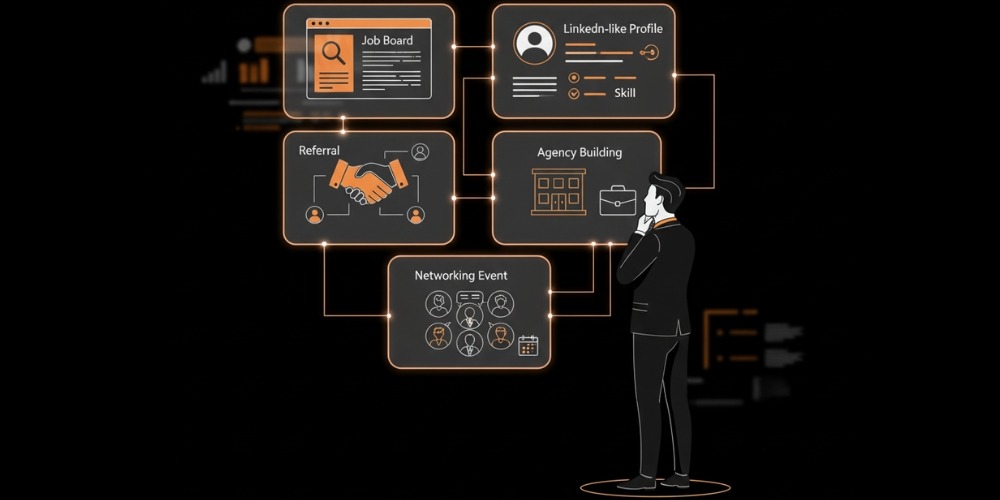
Online / digital channels
- Job boards — Indeed, Glassdoor, LinkedIn Jobs, niche specialty boards
- Social media and professional networks — LinkedIn, Twitter/X, Facebook groups, industry-specific platforms
- Talent databases — searchable CV repositories
- Careers pages and microsites — owned channels
- Paid programmatic ads — sponsored job promotions
Zippia social media recruiting data shows ~57% of candidates use social media in their job search and 92% of organisations use social platforms in their recruiting mix.
Referral and internal channels
- Employee referrals (consistently the highest quality-of-hire channel)
- Alumni networks and boomerang hires
- Internal mobility and past-applicant databases
Agency and third-party channels
- Recruitment agencies and staffing firms
- Outsourced sourcing services
- Executive search and headhunters
Used most effectively for hard-to-fill, urgent, or senior roles where in-house capacity can't keep up.
Offline and event-based channels
- Job fairs and career events
- Campus recruiting and university partnerships
- Industry conferences and meetups
- Local print and media ads (still effective in some markets)
Proactive outbound channels
- Direct outreach via LinkedIn InMail or email
- Boolean sourcing on platforms
- Passive candidate engagement
- Industry-specific community participation
How to Match Channels to Roles
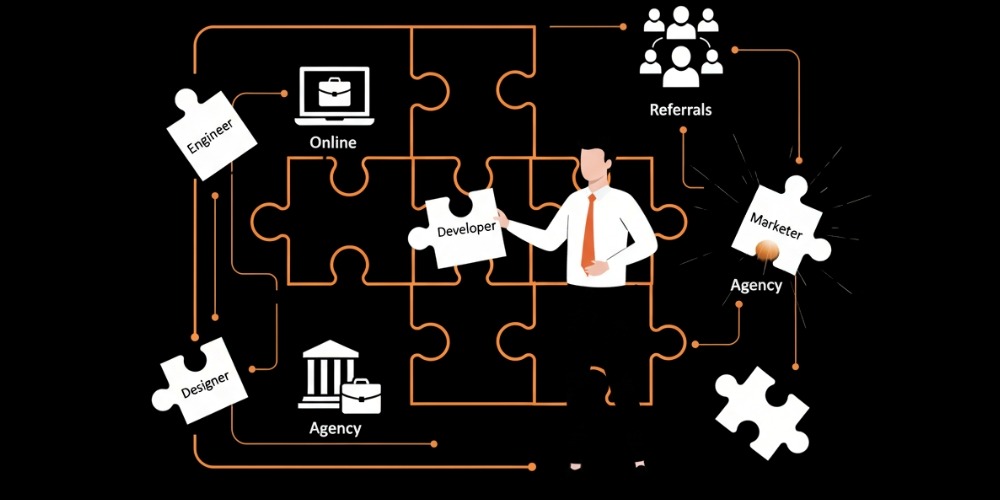
1. Profile the candidate
Is the ideal candidate actively searching (junior, generalist) or passive (senior, specialist)? Active candidates congregate on job boards and social media; passive candidates require outreach to specialist communities and direct messaging.
2. Match by role complexity
| Role profile | Strong channels |
|---|---|
| Junior generalist | Job boards, social media, campus events |
| Mid-level specialist | LinkedIn, niche communities, referrals |
| Senior leadership | Executive search, direct outreach, network |
| Hard-to-fill technical | Specialist forums, niche platforms, headhunters |
| High-volume operational | Job boards, employment exchanges, social ads |
3. Consider budget, timeline, and volume
- Tight timeline: boosted ads, agencies, internal talent pool
- Tight budget: referrals, alumni networks, careers page, organic social
- High volume: multi-channel paid + referral programs scaled
4. Mix and test
Use a structured mix — one high-volume channel, one niche channel, one referral channel. Monitor each. Drop underperformers; double down on what works for that role type.
5. Stay flexible
Channel performance shifts. Candidate behaviour evolves. Tools change. Revalidate the mix quarterly to stay ahead of decay.
How to Measure Channel Effectiveness

Six metrics that consistently reveal channel performance.
Source of hire (SoH)
Which channel produced each hire. If 40% of hires come from referrals, that's a strong signal to invest more in referral programs.
Cost per hire by channel
Total spend on a channel divided by hires produced. Cheap channels with low conversion can be more expensive than expensive channels with high conversion.
Time to fill by channel
How long from first candidate contact to offer acceptance. Channels that compress this time without sacrificing quality are valuable.
Quality of hire by channel
90-day retention and performance ratings by source-of-hire channel. The cheapest channel with the worst quality-of-hire is the most expensive choice in real terms.
Conversion rate by stage
Where candidates drop off in each channel. A channel with high applications but low interviews has a quality problem; a channel with high interviews but low offers has a fit problem.
Retention by channel
12-month and 24-month retention rates by hire source. Long-term performance is what matters; short-term hires that don't stick are expensive failures.
Setting Up Channel Tracking
Three practical steps that make channel measurement work.
1. Tag every candidate with source
ATS field, UTM parameters on job post links, manual entry by recruiters. Every candidate should have a source-of-hire tag from intake forward.
2. Aggregate monthly or quarterly
Total candidates per channel, hires per channel, cost per channel, time-to-hire per channel. Compare to baseline and to other channels.
3. Cut and reinvest
Drop channels with high cost and low quality. Reinvest in channels with strong returns. Always run one experimental "testing channel" alongside the proven ones to discover emerging sources.
How Strong Sourcing Strengthens Talent Assessment
The quality of your sourcing determines the quality of your assessment. When candidates come from focused, role-appropriate channels, downstream assessment tools work better — there's less noise and stronger fit signal.
Pairing channel discipline with structured assessment (skills tests, work samples, behavioural interviews) produces the strongest hires. Without good sourcing, even the best assessment tool spends time on candidates who shouldn't have made it that far.
The Bottom Line
Candidate sourcing channels are not interchangeable. Each one suits specific role profiles, budgets, and urgency levels — and choosing badly produces high cost-per-hire while quality candidates slip through. The teams that source well make deliberate choices: match the channel to the role, measure outcomes by channel, drop what doesn't work, and reinvest in what does. The compounding effect across a year of hiring is significant — strong sourcing reduces cost, lifts quality, and accelerates the funnel without anyone working harder.
FAQs
How many sourcing channels should a recruiter use at once?
Most strong programs use 3-5: one broad (major job board), one niche (industry-specific), one referral/internal, and often one outbound. Adjust based on what your data shows over a quarter.
Are offline channels still relevant in a digital-first world?
Yes — particularly for local, non-tech, and underserved markets. Job fairs, campus events, and local advertising still produce strong candidates in many regions and industries.
Do different industries need different sourcing channels?
Significantly. Tech roles benefit from GitHub, niche coding communities, and hackathons. Healthcare and education respond to professional associations and industry boards. Manufacturing often relies on local job boards and direct community partnerships.
Are paid channels worth the investment vs free ones?
It depends on what they deliver. Paid channels accelerate hiring and reach niche talent. If free channels (referrals, alumni, organic social) already deliver, weigh paid spend carefully against incremental return.
What's the highest-leverage channel for most companies?
Employee referrals. They consistently produce the highest quality-of-hire and retention metrics across industries — and they're typically the lowest cost. Invest in a structured referral program before scaling other channels.
Keep reading


