

Conversational AI Recruiting Chatbots: Practical Use, Real Limits
Conversational AI chatbots speed up early hiring conversations — what they do well, where they fall short, and how to deploy them without losing the human.
Ployo Team
Ployo Editorial
TL;DR
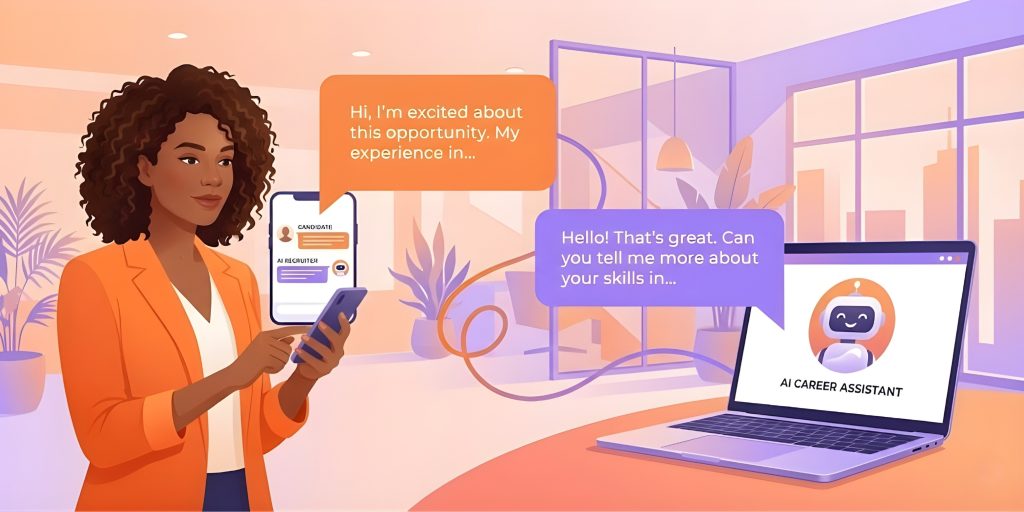
- Conversational AI chatbots handle the first hello, FAQs, and scheduling — freeing recruiters for the conversations that actually matter.
- Around 52% of hiring teams now use recruiting chatbots or texting platforms in some form.
- They excel at speed and consistency; they fall short on nuance, judgement, and edge cases.
- Responsible deployment requires clear escalation paths, transparency, and ongoing bias review.
- Chatbots are not the future of recruiting alone — the hybrid model (chatbots + humans) is.
Modern hiring funnels lose candidates in the gaps. Slow first responses, repetitive Q&A, and scheduling friction silently push qualified people toward competitors with faster pipelines. Conversational AI recruiting chatbots fill those gaps with always-on first responses, structured screening, and automated scheduling — without replacing the human judgement that closes hires. This guide walks through what these tools genuinely do well, where they fall short, and how to deploy them so the candidate experience improves rather than degrades.
What Conversational AI Recruiting Chatbots Are
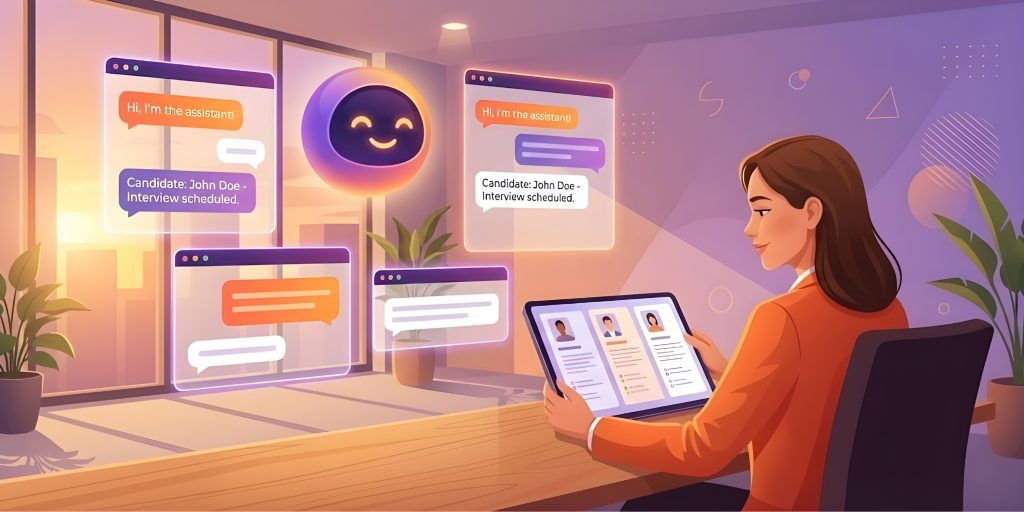
A conversational AI recruiting chatbot is a software assistant that engages job seekers in real-time text or voice conversations. Modern chatbots — increasingly powered by LLMs rather than rule-based decision trees — adapt to candidate language, answer questions in natural conversational style, and route to humans when the conversation moves beyond their scope.
Core capabilities of a serious modern recruiting chatbot:
- 24/7 first-response to applications and inquiries
- FAQ handling — pay, location, work permits, benefits
- Structured pre-screening with consistent question sets
- Interview scheduling with calendar integration
- Status updates and basic candidate nurture
- Handoff to a human recruiter at defined trigger points
SelectSoftware Reviews data shows around 52% of hiring teams now use recruiting chatbots or texting platforms in their workflow. The number reflects a real shift, not a hype cycle — chatbots solve concrete operational problems.
Why Teams Adopt Recruiting Chatbots
The case for chatbots is mostly operational, not technological.
First responses set the tone
Candidates who get a same-day response are dramatically more likely to stay engaged than those who wait days. The chatbot is the first interaction — and the quality of that interaction shapes the candidate's read of the entire company.
Volume scales without breaking the team
A single chatbot can handle hundreds of simultaneous conversations. The same volume manually would require multiple full-time coordinators. For high-applicant-volume roles, the unit economics are decisive.
Consistency reduces noise
When every candidate is asked the same opening questions in the same way, the downstream comparison is cleaner. Variability between recruiters at the screening stage causes more bad-hire mistakes than people realise.
Recruiter time shifts to high-leverage work
Removing repetitive FAQ work and scheduling friction lets recruiters focus on the judgement calls — closing conversations, negotiation, relationship-building — that machines cannot reliably do.
What Chatbots Do Well
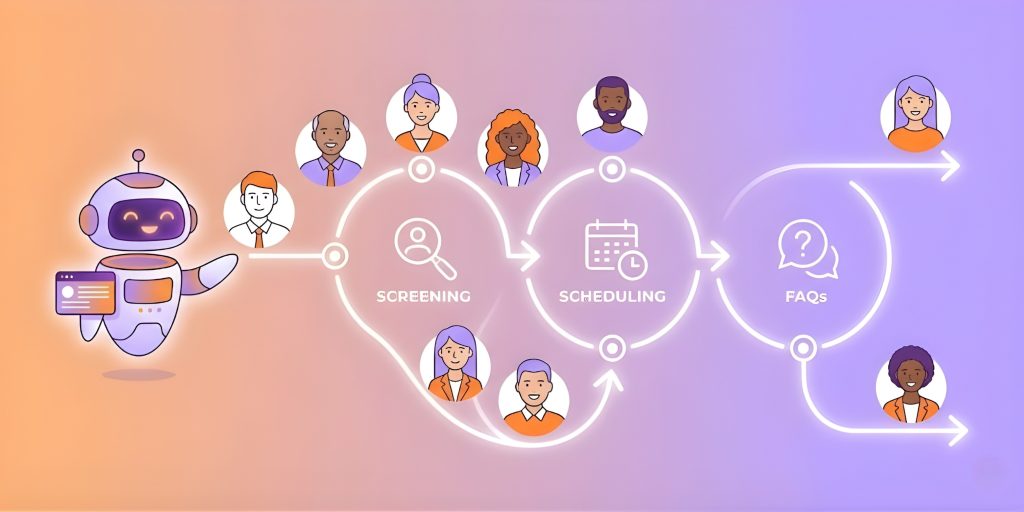
The strongest use cases share a pattern: high-volume, low-judgement, time-sensitive interactions.
| Strong fit | Why |
|---|---|
| Application acknowledgment | Immediate response improves candidate retention |
| FAQ handling | Same questions answered consistently 24/7 |
| Structured pre-screening | Consistent questions enable cleaner downstream comparison |
| Interview scheduling | Calendar friction is one of the largest drop-off points |
| Status updates | Reduces "where am I in the process?" tickets |
| Job recommendation | Surface relevant openings from the company catalog |
Chatbots can also feed cleaner structured data to downstream systems — short, focused answers are easier to evaluate than free-form resume narrative, which makes integrations with AI assessment platforms more reliable.
Where Chatbots Fall Short
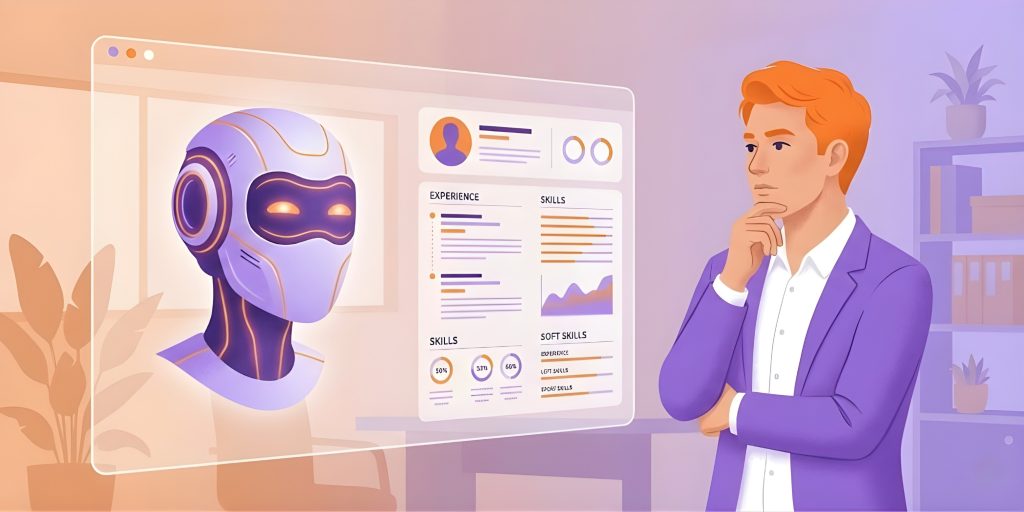
Honest limitations, in order of how often they cause problems.
Nuance and context
Career gaps, complex backgrounds, unusual situations — chatbots either miss the signal or respond in ways that feel tone-deaf. A candidate disclosing caregiving responsibilities or a recent layoff needs a human, not a script.
Voice and brand
Poorly tuned chatbots sound robotic and brand-damaging. Candidates can tell when they're talking to a generic template versus a thoughtfully designed conversation, and the difference shows up in completion rates.
Bias risk in training data
If the chatbot is trained on historic interactions, it can perpetuate the language patterns and screening biases of that history. Inclusive-language audits and ongoing fairness review are not optional.
Escalation friction
A chatbot that won't let candidates reach a human is the single fastest way to destroy candidate experience. The escalation path matters more than the chatbot's quality on its own.
Edge cases
Complex location/visa questions, unusual scheduling needs, accessibility accommodations — all benefit from human handling.
When the Chatbot Should Step Aside
A useful design principle: chatbots own the early funnel; humans own the moments of judgement.
Trigger points where a chatbot should hand off:
- Candidate shares personal context the script does not cover
- Candidate explicitly requests a human
- Skills evaluation needs depth beyond multiple choice
- Culture-fit conversations begin
- Offer negotiation or compensation discussion
- Accessibility or accommodation requests
- Repeated misunderstanding signals
The handoff should be smooth, named, and time-bound — "I'm bringing in Sarah from our recruiting team; she'll reach out within 24 hours" is dramatically better than "Sorry, I can't help with that."
How AI Platforms Use Chatbots Responsibly
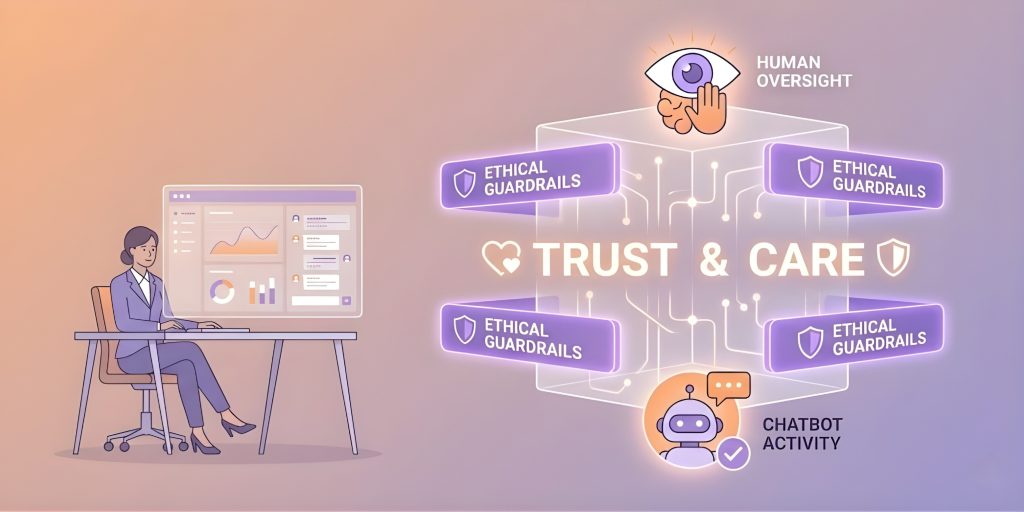
Responsible deployment shares a few non-negotiable practices.
Transparency about the AI
Candidates should know they're talking to a bot, not a person. Disclosure builds trust; opacity damages it.
Bot does not make final decisions
The chatbot can screen, score, and rank, but the decision to reject or advance should stay with humans. This is both an ethical and a legal-defensibility position.
Data minimisation
Collect only what the screening actually needs. Explain why each piece is collected. Honor regional data protection requirements (GDPR, CCPA, etc.) by design.
Ongoing bias audits
Audit chatbot conversations for adverse impact, response quality, and tone consistency. Build feedback loops where recruiters can flag bad responses and improve them.
Human-first escalation
Always provide a route to a real person. "Talk to a human" should be a one-word command, not a five-step process.
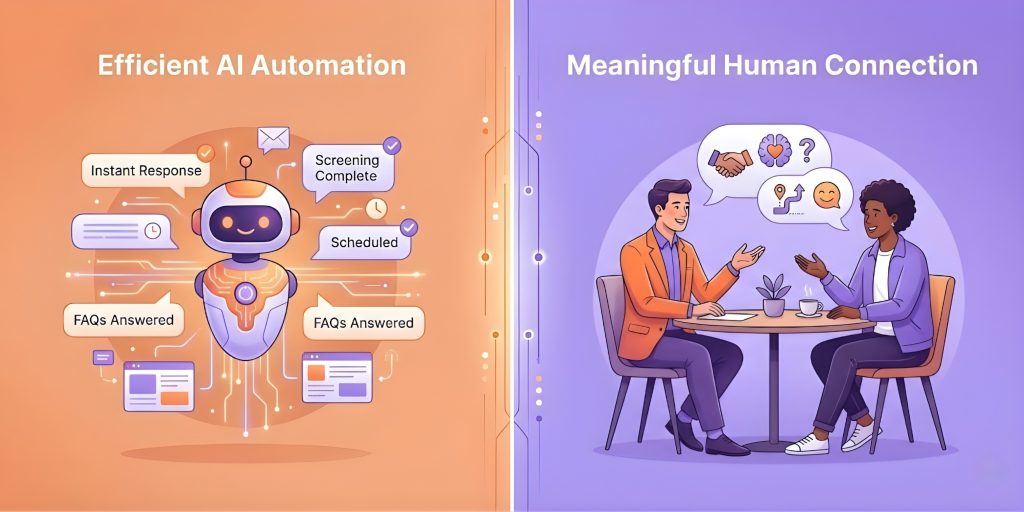
Chatbots vs Human Recruiters: A Partnership, Not a Battle
| Strength | Chatbot | Human recruiter |
|---|---|---|
| Speed of response | Instant | Hours to days |
| Consistency | Perfect | Variable |
| Availability | 24/7 | Business hours |
| Empathy and context | Limited | Strong |
| Judgement on edge cases | Weak | Strong |
| Relationship-building | None | Core capability |
| Closing offers | None | Essential |
The honest read: chatbots clear the path; recruiters guide the journey. Teams that lean too far on either side end up with hiring that's either cold or slow.
What Candidate Experience Actually Demands
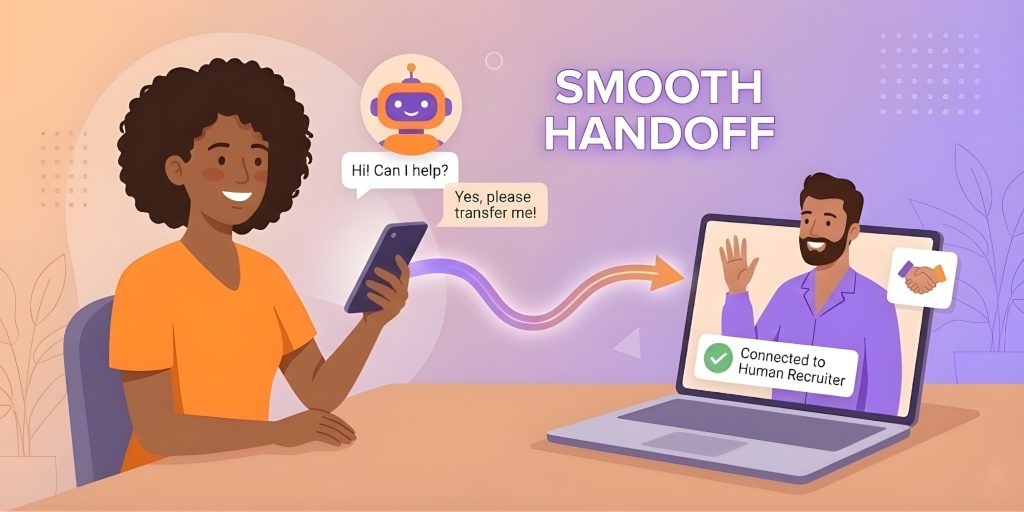
The candidate-experience test for any chatbot deployment is simple: would a strong candidate feel respected by this experience?
Indicators of good experience design:
- Short, conversational messages — not corporate templates
- Clear next steps after every interaction
- Always-available human handoff
- Status visibility — candidates know where they are in the process
- Reasonable response time SLA when humans take over
- Accessibility — the chatbot should work for all candidates, not just typical ones
Indicators of bad design:
- Long scripted blocks of text
- No escalation path to a person
- Generic language that doesn't reflect company culture
- Ambiguous next steps
- Repetitive loops when the bot doesn't understand
The chatbot is part of the brand. Treat it like a hire whose first day reflects on the whole company.
The Bottom Line
Conversational AI recruiting chatbots solve real, expensive operational problems — slow first responses, repetitive Q&A, scheduling friction — without replacing the human judgement that closes hires. The teams getting the most value from them deploy them as a support layer, not a replacement: chatbots handle the predictable, scalable parts of the funnel; recruiters handle the judgement, empathy, and relationship work that matters most. Done well, candidates barely notice they're interacting with AI early on, and the recruiting team operates with the efficiency of one twice its size. Done badly, the chatbot becomes the most-hated thing about the brand. The technology is mature; the discipline of deployment is what separates winners from cautionary tales.
FAQs
Do candidates actually like chatbots?
Most do when the chatbot is genuinely useful and the escalation to a human is easy. Frustration spikes when the chatbot blocks access to people. Speed and helpfulness drive satisfaction; opacity and rigidity destroy it.
Can chatbots reduce hiring bias?
Yes, if they're built and audited correctly. Consistent screening questions reduce recruiter-to-recruiter variability. But chatbots can also encode historic bias if trained on biased data, so ongoing fairness audits are required.
Will chatbots replace human recruiters?
No. They reshape the recruiter role rather than replace it. Repetitive work shifts to the chatbot; recruiters focus on judgement, relationships, and closing — areas where humans remain essential.
What's the most common chatbot deployment mistake?
Removing the human-handoff option to "save costs." The trade-off is almost always a net loss because candidate-experience damage costs more than the saved recruiter time.
How do I choose a chatbot platform?
Evaluate language model quality, integration with your ATS, transparency of decision logic, audit capabilities, candidate-experience design, and the strength of the escalation paths. Generic chatbots without recruiting-specific design produce poor outcomes regardless of underlying model.
Keep reading

Interview Schedule Templates and Tips: A Practical Recruiter Guide

Talent Assessment Tools in 2026: A Practical Recruiter Buying Guide
