

Interview Schedule Templates and Tips: A Practical Recruiter Guide
Clear interview schedules cut recruiter time and improve candidate experience — free templates, tips for customization, and common mistakes to avoid.
Ployo Team
Ployo Editorial
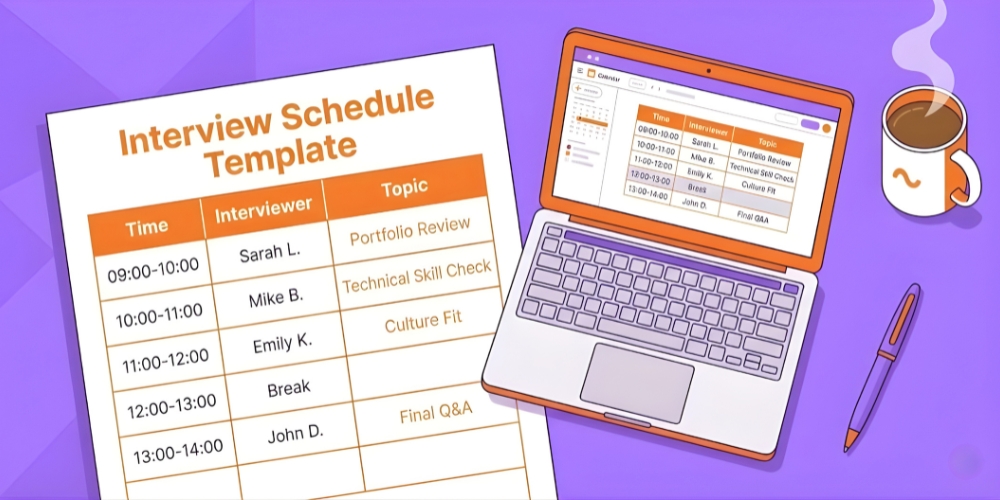
TL;DR
- Recruiters spend ~35% of their time on interview scheduling (SelectSoftware Reviews).
- 66% of candidates say hiring experience influences whether they accept an offer (CareerPlug).
- Strong schedules cover time, interviewer, format, location, and prep notes.
- Common templates: simple table, full-day format, candidate email, assessment agenda, multi-location.
- AI scheduling tools dramatically compress the scheduling workload.
Interview scheduling consumes more recruiter time than people realise — roughly 35% per industry benchmarks. Done well, it improves candidate experience, keeps internal teams aligned, and frees recruiter capacity for the work that requires human judgement. Done badly, it produces missed interviews, frustrated candidates, and drop-off that better scheduling would have prevented. This guide provides templates you can use today, tips for customising them, and the mistakes that consistently weaken otherwise capable hiring teams.
What an Interview Schedule Template Is
An interview schedule template is a pre-formatted document outlining time, participants, and activities for an interview day or session. Strong templates answer four questions: who, what, when, where.
Common formats:
- Simple table — time-slot grid for one-on-one or small panel interviews
- Full-day format — multi-stage interviews with breaks and panel assignments
- Email format — confirmation message sent to candidates
- Assessment agenda — technical roles with tests and presentations
- Multi-location form — for interviews spanning rooms or sites
The right template saves recruiter time while creating a consistent candidate experience.
Why Interview Scheduling Matters
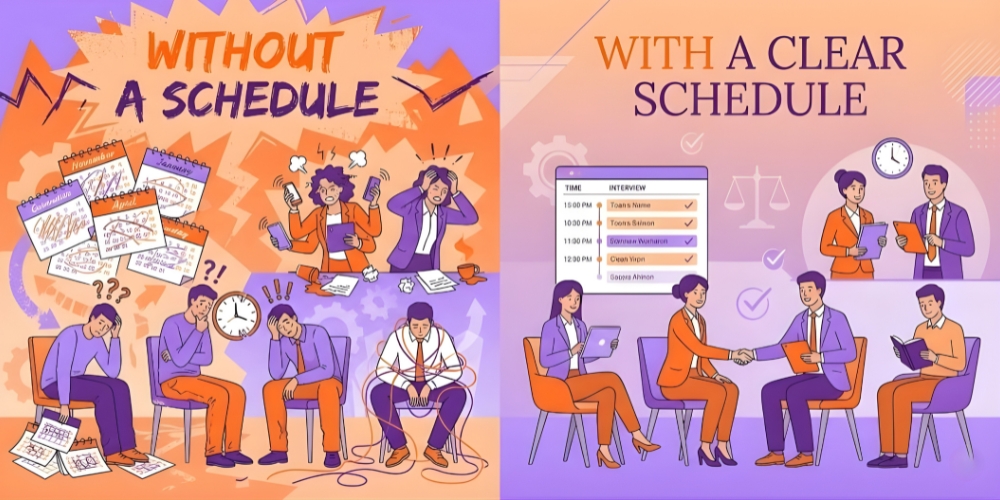
Three operational reasons scheduling deserves real attention.
Efficiency saves recruiter time
SelectSoftware Reviews 2025 recruiting data shows ~35% of recruiter time goes to interview scheduling. Even modest efficiency gains here free significant capacity.
Candidate experience shapes acceptance
CareerPlug candidate experience research shows 66% of candidates say hiring experience influences whether they accept an offer. Scheduling is one of the first concrete experiences candidates have — clear, organised scheduling builds trust.
Internal team alignment
Hiring involves recruiters, hiring managers, panel members, and sometimes external stakeholders. Without clear scheduling, people miss interviews, duplicate questions, or contradict each other in front of the candidate.
Ready-to-Use Templates
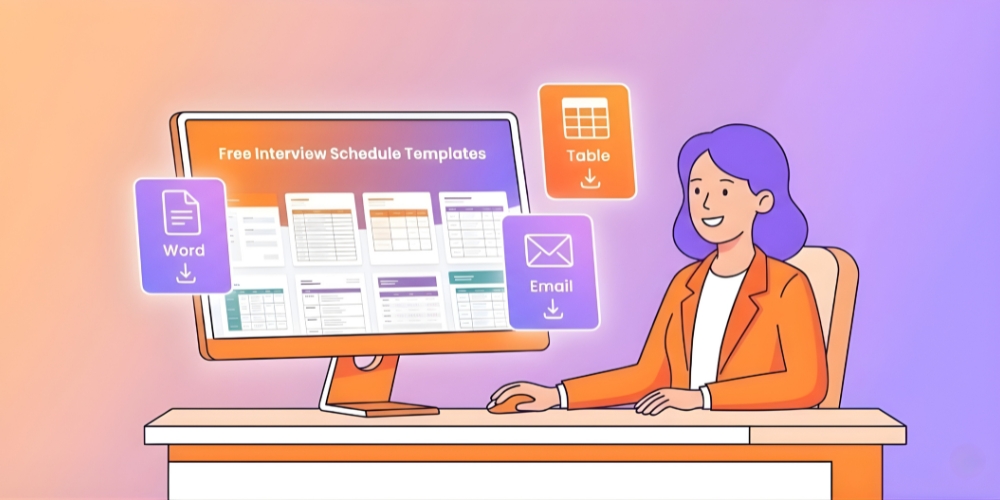
Template 1: Simple table
For one-on-one or small panel interviews.
| Time | Interviewer | Candidate | Topic/Focus | Notes |
|---|---|---|---|---|
| 09:00 | Jane Doe | John Smith | Intro + role fit | Zoom link |
| 09:30 | Jane Doe | John Smith | Technical review | Send test |
| 10:00 | Mike Chen | John Smith | Culture conversation | In-person |
Use for: most standard interview rounds.
Template 2: Full-day format
For multi-stage interviews spanning hours.
Cover blocks:
- Welcome and introductions (15 min)
- Manager interview (45 min)
- Break (15 min)
- Technical assessment (60 min)
- Lunch with team (60 min)
- Skip-level interview (45 min)
- Culture conversation (30 min)
- Q&A and close (15 min)
Use for: senior or technical roles with deep evaluation.
Template 3: Candidate confirmation email
Subject: Interview Confirmation — [Role Name]
Hi [Candidate Name],
Thanks for your interest in the [Role] role. Your interview is confirmed:
Date and time: [Date] at [Time] [Timezone] Format: [In-person at address / Zoom link] Schedule:
- [Time] – [Interviewer/Panel] – [Format]
- [Time] – [Interviewer/Panel] – [Format]
Please arrive 10 minutes early. Bring [documents/portfolio].
If you need to reschedule, reply to this email.
Best regards, [Your Name]
Template 4: Assessment-focused agenda
For technical roles requiring skills tests.
| Time | Activity | Owner | Materials |
|---|---|---|---|
| 10:00 | Coding test | Team Lead | Laptop, IDE |
| 11:30 | Solution walkthrough | Hiring Manager | Feedback sheet |
| 12:00 | Behavioural interview | HR Manager | Structured rubric |
Template 5: Multi-location form
For interviews spanning rooms or sites.
| Room | Time | Candidate | Interviewer | Notes |
|---|---|---|---|---|
| 4B | 09:00 | Jane Lee | Sarah K. | Manager interview |
| 5A | 10:00 | Jane Lee | Panel (3) | Technical |
| 4B | 11:30 | Jane Lee | David T. | Culture |
Tips for Customising Schedules
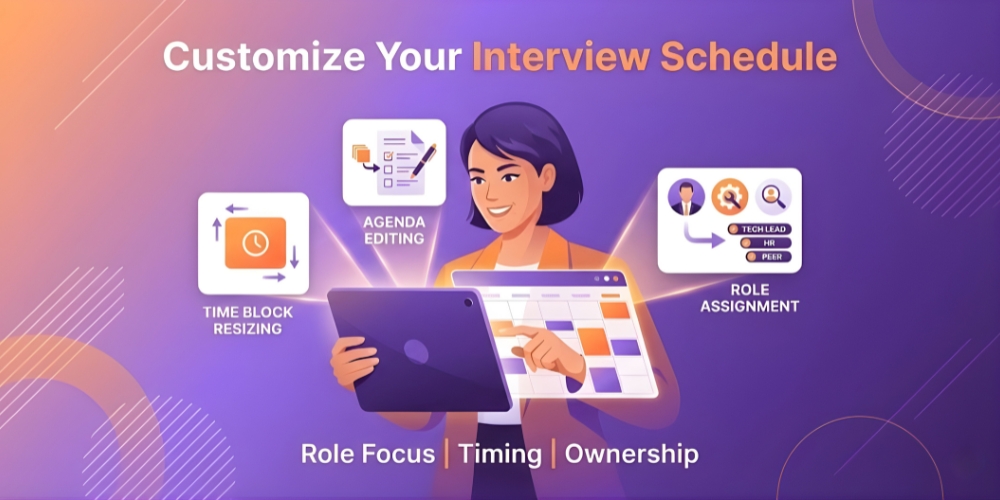
Five practices that consistently produce better schedules.
Match length to role level
Entry-level: 30-90 minutes total interview time. Mid-level: 90-180 minutes. Senior leadership: half-day or full-day. Senior candidates expect deeper evaluation; entry candidates don't.
Define each session's purpose
Each interview block should have explicit purpose — experience review, problem-solving, team fit, technical depth. Without explicit purpose, interviews drift into duplicate territory.
Build in real breaks
10-15 minutes between interview blocks. Without breaks, schedules slip; candidates and interviewers both lose energy as the day progresses.
Single schedule owner
One person responsible for keeping the schedule current. Multiple owners produce inconsistent communications and confused candidates.
Send the schedule in advance
24-48 hours before the interview. Gives candidates time to prepare and reduces day-of confusion.
Common Scheduling Mistakes
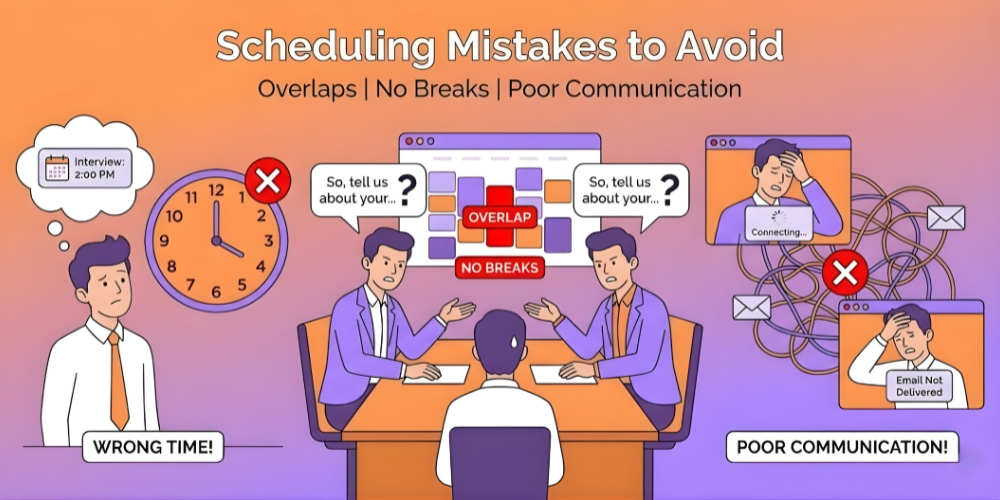
Five recurring failures.
Packing the day too tight
Back-to-back interviews without breaks produce rushed conversations and fatigued interviewers. The cumulative quality damage outweighs the time savings.
Unclear messaging
Calendar invite alone doesn't explain what to expect. Detailed scheduling email with format, prep expectations, and panel introductions improves candidate confidence and conversion.
Time zone confusion
Especially for remote hiring. Always specify timezone explicitly. "10 AM" can mean four different things across time zones; "10 AM ET" is unambiguous.
Lack of interviewer alignment
When panel members don't coordinate, they ask the same questions or contradict each other. A pre-interview alignment call (15 minutes) prevents this.
No buffer for overruns
Tight schedules cascade — when an interview runs 5 minutes long, every subsequent interview starts late. 15-minute buffers between sessions absorb the inevitable variance.
How AI Improves Interview Scheduling
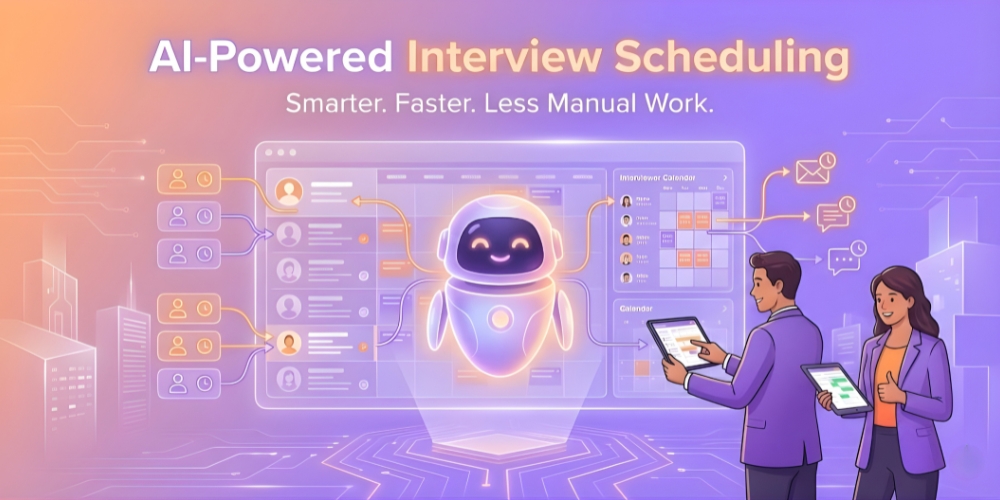
Modern scheduling tools (Calendly, GoodTime, native ATS scheduling) compress the work substantially.
Automatic availability matching
Candidates self-schedule into available interviewer slots. Eliminates the email back-and-forth that consumes recruiter time.
Conflict detection
System flags double-booked interviewers or candidate conflicts before they become real-world problems.
Reminder automation
Automatic reminders to candidates and interviewers reduce no-show rates. Pre-interview prep notes can be included.
Integration with assessment platforms
When scheduling integrates with pre-employment screening, only qualified candidates reach interview stages. Recruiter capacity goes to the conversations that matter.
AI in interview workflows increasingly combines scheduling with async video, assessment, and even AI-driven initial screening.
Interview Scheduling and Candidate Experience

Scheduling is often the candidate's first concrete experience with your company. Three principles consistently produce strong candidate experience.
Show respect for candidate time
Send schedules in advance, confirm details proactively, send reminders, don't reschedule without genuine cause.
Provide context
Tell candidates who they'll meet, what each session covers, what to prepare, and what to bring. Eliminates anxiety and improves interview quality.
Offer flexibility where possible
Multiple time slots, multiple format options (in-person/video where appropriate), accommodation for time zone or accessibility needs.
The brand impact of strong scheduling compounds across many candidates over time — reputation as "they're organised and respect my time" travels.
The Bottom Line
Interview scheduling is more strategic than it appears. The 35% of recruiter time it consumes is reclaimable through templates, process discipline, and modern tooling. The candidate experience it shapes affects offer acceptance and employer brand. The internal alignment it enables makes interview quality consistent across panels. Strong scheduling isn't glamorous, but it compounds across every hire — reclaimed recruiter capacity, stronger candidate experience, better internal coordination. Start with a template that fits your role profile, customise for your team and process, and use modern tooling to handle the mechanics. The discipline pays back immediately and continues paying back across years.
FAQs
What's the best interview schedule format?
Depends on the role. Simple tables work for most standard interviews; full-day formats fit senior or technical roles; email-based confirmation works for all candidate-facing communication. Match the format to the role profile.
How long should interviews actually last?
30-60 minutes per session is standard. Total interview time across rounds: 90 minutes for entry-level, 3-4 hours for mid-level, half-day or full-day for senior leadership.
Should candidates receive the schedule in advance?
Yes — 24-48 hours minimum. Earlier notice reduces day-of confusion, helps candidates prepare, and signals organisational respect.
Can interview scheduling be fully automated?
The mechanics yes; final decisions no. Modern tools handle availability matching, reminders, and reschedules automatically. Recruiters still own the strategic decisions (which candidates advance, what panel composition).
What's the highest-leverage scheduling improvement?
Single-owner accountability. When one person owns the schedule end-to-end, communications stay consistent and changes get coordinated. Multiple-owner scheduling consistently produces confused candidates and misaligned panels.
Keep reading

Conversational AI Recruiting Chatbots: Practical Use, Real Limits

Talent Assessment Tools in 2026: A Practical Recruiter Buying Guide
