

AI Resume Detection: Can Recruiters Really Spot AI-Written CVs?
AI resume detectors help filter AI-written CVs — how they work, why detection is imperfect, and the hybrid workflow that actually keeps screening fair.
Ployo Team
Ployo Editorial
TL;DR
- Around 45% of job seekers now use AI tools to write or polish resumes — detection has become a real concern for hiring teams.
- AI resume detectors flag patterns like generic phrasing, lack of personal detail, and unnaturally uniform writing.
- Detection is imperfect: false positives are common, candidates blend human and AI writing, and detection accuracy decays as AI tools improve.
- The hybrid model — AI detection as one signal among several, with human review on every decision — is what works in practice.
- Screening is shifting from "did AI write this?" to "do the claims hold up against work samples and interviews?"
The line between human-written and AI-written resumes has blurred. With around 45% of job seekers using AI tools to write or polish their CVs, the screening question has shifted — from spotting fake credentials to deciding whether AI assistance even matters when it does not affect the underlying truth of the application. This guide breaks down what AI resume detectors actually do, why detection is structurally imperfect, and the hybrid screening model that keeps hiring fair without slowing it down.
The Rise of AI-Generated Resumes
The shift happened fast. AI writing tools exploded in 2023 and 2024, and Canva's 2024 research found that around 45% of job seekers now use generative AI tools to enhance their resumes. Job hunters use them to fix grammar, rewrite experience, add keywords, and produce "ATS-friendly" versions that boost their chances of passing automated screening.
The same tools also help with cover letter checking, resume optimisation, and ATS-format compliance. Strong candidates can produce a polished, keyword-optimised resume in minutes. The hiring side response has been to develop detection tools — and to rethink what the resume signal actually means.
The volume of AI-written applications has pushed employers to use detection tools, AI resume analyzers, and ATS-integrated filters to understand who actually wrote what. The trend is forcing the broader hiring industry to think more carefully about what it is screening for.
What an AI Resume Detector Actually Is
An AI resume detector reviews the text in a resume and estimates the probability that parts of it were AI-generated. The detection focuses on:
- Repetitive sentence structures
- Unnaturally uniform tone across different sections
- Lack of personal voice or specific detail
- Predictable vocabulary patterns associated with AI writing models
- Unusually balanced phrasing where humans typically vary
The tools sit inside hiring platforms alongside ATS scanners and resume parsers. They support broader screening workflows by flagging applications worth a closer look — but they are not authoritative judges.
The honest reality: large enterprises and tech-forward HR teams use these tools the most. Smaller teams generally skip them in favour of focusing on interview rigour and work-sample testing. Both approaches are defensible.
Why Detecting AI Resumes Is Structurally Hard
Detection is harder than it sounds, and gets harder as AI writing tools improve. Four specific challenges.
AI mirrors human writing styles
Modern AI tools train on millions of human writing samples. The output blends in naturally — including occasional minor errors, varied sentence lengths, and tone shifts that mimic human writing patterns.
Candidates mix human and AI writing
When applicants use AI for one section but write others themselves, detection accuracy drops sharply. Most real-world resumes are partially AI-edited rather than entirely AI-generated.
Different AI tools produce different signatures
A resume drafted in ChatGPT looks different from one produced by specialised resume-writing tools. Detection models trained on one type of output may miss others entirely.
False positives are common
A well-written human resume — particularly from a candidate with strong writing skills or a recent journalism background — can trip the detector. Penalising those candidates is unfair and legally risky.
The result: most thoughtful hiring teams now focus on structure and content quality rather than pure writing-origin detection. They check whether the resume passes ATS parsing rules cleanly, whether the content is readable, and whether the claims align with interview answers. Common phrasing — what we cover in resume buzzwords to avoid — often triggers detection signals even on entirely human-written resumes.
Can Recruiters Actually Spot AI Resumes Reliably?
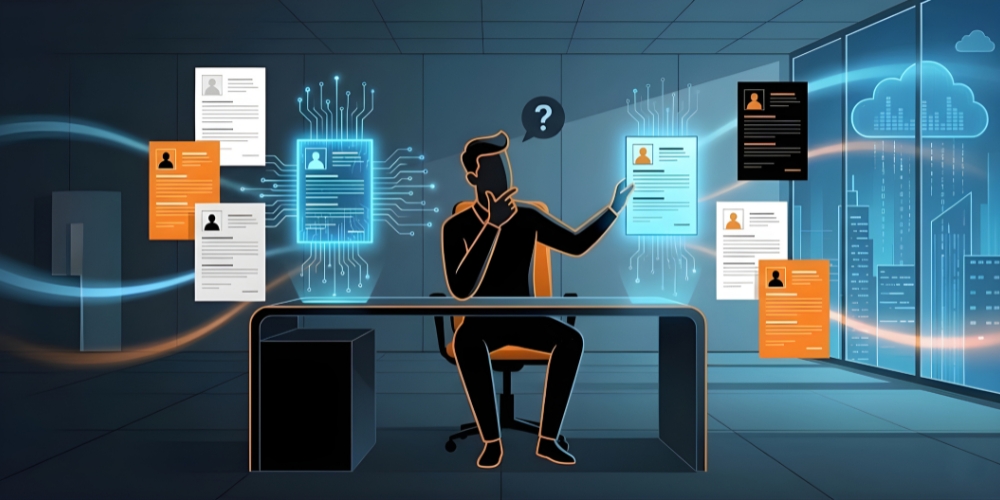
The honest answer: sometimes. Recruiters can identify clear signs — generic wording, no specific achievements, inconsistent timelines — but writing style alone does not tell the whole story.
Most recruiters do not read resumes hunting for AI; they read for skills and fit. What matters is whether the resume matches the role, makes coherent sense, and aligns with interview performance and work samples.
The hybrid workflow that works in practice:
- AI scans the resume for structure, format, and surface signals
- Recruiter reads for substance and specific achievements
- Interview probes the claims with concrete follow-up questions
- Work samples or skills tests verify capability directly
Pattern that holds up: focus on alignment between resume claims and what the candidate can actually demonstrate in interviews. The resume's writing style becomes secondary when the underlying truth is what gets verified.
False positives in detection are common enough that experts treat AI detection as one signal among many, never as a hiring decision in itself. The decision belongs to the human reviewer who weighs detection results against everything else.
The Future: AI vs AI in Resume Screening
Hiring is moving into an "AI vs AI" phase — candidates use AI to write resumes, employers use AI to screen them. The screening side is rapidly adapting.
SHRM Labs' research on AI in recruiting reports that 35-45% of companies have adopted AI in their hiring processes, particularly for screening and matching. As adoption grows, resume detection becomes a smaller part of a larger system that evaluates skills, alignment, and truthfulness end to end.
Three shifts already underway:
More weight on work samples
As resumes become easier to polish, the relative weight of skill demonstrations rises. Short tasks, code samples, and structured assessments become the more trusted signal.
Smarter detection tools
AI detection itself will improve, but so will AI writing. The arms race will continue; detection will become one input rather than a definitive verdict.
Transparent screening for candidates
ATS systems are becoming more transparent about how they evaluate, helping candidates structure resumes accurately without guesswork. The cat-and-mouse dynamic settles when both sides have clearer expectations.
The screening function is broadly shifting from "did AI write this?" to "do the claims hold up under real evaluation?" That shift is healthy — it focuses hiring on substance rather than form. Combined with strong resume screening practices in recruiting, the integrated approach produces more accurate hiring than any single detection layer could.
The Bottom Line
AI resume detection has a real place in modern hiring, but it should never be the deciding signal. The honest reality is that detection is imperfect, getting harder as AI writing improves, and prone to false positives. The hybrid model — AI detection as one input, paired with substantive interview probing and work-sample verification — is what produces fair, reliable hiring decisions. The teams that focus on whether claims are true rather than whether AI wrote the words tend to make better hires than teams trying to win an unwinnable detection arms race.
FAQs
What does an AI resume detector actually do?
It reviews resume text and estimates the likelihood that parts of it were AI-generated. The tool analyses writing patterns, sentence structure, vocabulary, and consistency — but produces probabilities rather than verdicts.
How accurate are AI resume detectors?
Imperfect — false positives are common, and detection accuracy decays as AI writing tools improve. They are useful as one input among several, not as definitive judges.
Should recruiters automatically reject AI-written resumes?
No. Many candidates use AI only for grammar polish or formatting. What matters is whether the claims are true and the candidate has the underlying skills — not whether the writing was AI-assisted.
What is the biggest pitfall in over-relying on AI detection?
False positives hurt real candidates. Strong writers — especially those with journalism or content backgrounds — frequently trip detection algorithms despite writing every word themselves. Treating detection as authoritative produces unfair rejections.
What should hiring teams focus on instead?
Substantive verification through interview follow-up, work samples, and structured skill demonstration. These reveal what the candidate can actually do, regardless of how their resume was written.
Keep reading

Pink Collar Jobs Explained: Definition, Examples, Salaries

Employee Lifecycle Stages: A Practical Guide for HR Leaders
