

Japan Job Culture and Work-Life Balance: What Workers Need to Know
Japan's job culture is shifting from long hours and hierarchy toward output-focused work — the changes that matter and what expats experience.
Ployo Team
Ployo Editorial
TL;DR
- 10%+ of full-time Japanese employees still work 60+ hours weekly.
- Japan's 2019 Work Style Reform capped overtime at 45 hours/month for most roles.
- Paid leave usage hit a record 62.1% in recent reporting.
- Foreign-capital firms (gaishikei), tech, and creative agencies lead on flexibility.
- Expats often have a cultural "buffer" against rigid social obligations.
Japan's job culture has historically emphasised long hours, strict hierarchy, and company loyalty over personal life — a system tied to the salaryman archetype and the genuine social phenomenon of karoshi (death from overwork). Recent reforms and generational shift are reshaping this. Younger workers expect flexibility; the government has set legal limits; foreign-capital firms model alternative norms; and Japan's demographic pressures make sustainable work practices increasingly urgent. This guide walks through what Japan's job culture actually looks like in 2026, how the work-life balance is shifting, and what foreigners can expect.
Core Elements of Japan's Job Culture
Three concepts shape traditional Japanese workplace dynamics.
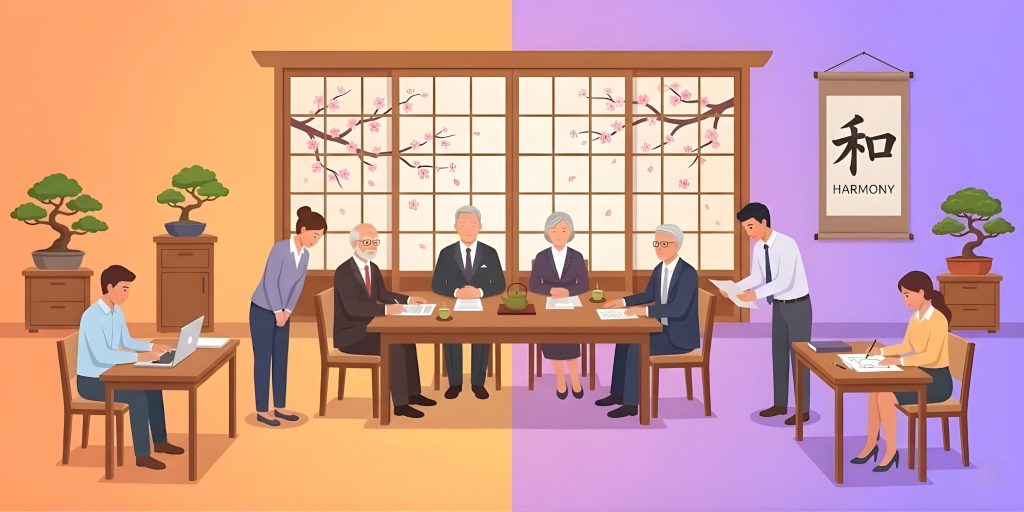
Wa (harmony)
Group cohesion typically matters more than individual achievement. Decisions often emerge through consensus rather than top-down direction. Public disagreement is rare even when private disagreement exists.
Giri (obligation)
Strong sense of obligation to the company and colleagues. Staying late when the boss is still working; attending after-hours social events (nomikai); supporting the team beyond formal job description.
Hierarchy (nenkou jousetsu)
Seniority-based system where respect flows upward. Decision processes (ringi) typically circulate proposals through multiple seniority layers before approval.
These elements interact to produce a workplace where individual freedom is constrained by collective expectations — and where deviation can carry meaningful social cost.
Overtime and Presenteeism Explained

Two specific cultural patterns drive long hours.
Presenteeism
The cultural expectation that physical presence at the desk signals loyalty, regardless of actual output. Leaving "on time" when others stay late can damage relationships and career trajectory.
Service overtime (unpaid)
Despite the formal 40-hour work week, "service overtime" extends days informally. The Japanese workday legally runs 8 hours; in practice 10-12 hours is common in traditional sectors.
The data
AOTS workforce data shows 10%+ of full-time employees still work 60+ hours weekly. While average overtime has decreased, the long-hours culture persists in many sectors.
Legal context
The legal limit is 40 hours/week, but "36 Agreements" between unions and management historically allowed higher ceilings. Recent 2024 reforms tightened caps in industries like construction and trucking.
Industry Differences

Three industry categories with meaningfully different cultures.
Traditional manufacturing and banking
Strict hierarchies, formal protocols, longer hours. Loyalty to single employer expected. Career progression follows tenure more than performance.
Tech and creative agencies
Pioneers of new Japanese work culture. Flextime, remote work, "No Overtime Wednesdays" becoming standard. Output-focused rather than presence-focused.
Foreign-capital firms (gaishikei)
Google, Amazon, Goldman Sachs, etc. in Japan typically mirror Western workplace standards. Output focus, flexibility, performance-based progression.
The industry choice matters significantly for work-life balance. Same country, dramatically different daily experiences.
Is Work-Life Balance Improving in Japan?

Carefully yes. Three signals of improvement.
Legal reform
Japan's 2019 Work Style Reform capped overtime at 45 hours/month and 360 hours/year for most roles. Compliance is improving though uneven.
Paid leave usage
Recent surveys show paid leave usage hitting a record 62.1% — substantially higher than historic baselines.
Generational shift
Younger workers (under 35) increasingly prioritise work-life balance. Companies competing for talent must adapt to retain them.
The trend is positive but uneven. Many traditional sectors retain long-hours norms; reform is fastest in tech, foreign-capital, and consumer-facing roles.
What Expats Experience

Foreign workers often experience Japanese workplaces differently than Japanese colleagues — sometimes more positively.
The cultural buffer
Foreigners are sometimes exempt from the most rigid social obligations. Staying late at nomikai or waiting for the manager to leave are less mandatory.
Job concentration in flexible sectors
Many expats work in international firms or startups that already prioritise diversity and flexibility. Their experience reflects gaishikei culture rather than traditional Japanese culture.
Language and cultural complexity
The flip side: navigating workplace expectations without fluent Japanese is challenging. Subtle cues, indirect communication, and hierarchical signals all require cultural fluency that takes years to develop.
What expats consistently report
- Easier than expected for those at foreign-capital firms
- Significantly harder at traditional Japanese companies
- Strong support networks among foreign professionals
- Some career ceiling at fully-Japanese firms despite competence
Tips for Working in Japan
Five practices that consistently help workers navigate Japanese job culture.
1. Choose your employer carefully
The same role at a Japanese trading company vs Google Japan produces fundamentally different daily experiences. Research culture before accepting.
2. Learn the basics of indirect communication
Japanese workplace communication often signals through implication and silence rather than explicit statement. Reading what's not being said matters.
3. Participate in social rituals selectively
Some nomikai attendance is valuable for relationship-building; you don't need to attend every one. Pick the ones that matter for your specific colleagues.
4. Track legal protections
Know your rights under Japanese labour law and Work Style Reform. Many workers don't realise they're being asked to violate legal protections.
5. Build relationships across generations
Younger Japanese colleagues often share your interest in better work-life balance. Build community with them; learn from older colleagues about navigation.
The Bottom Line
Japan's job culture sits at an inflection point. Traditional norms (long hours, strict hierarchy, presenteeism) persist in many sectors but are receding in others. Legal reform, generational shift, and global competition for talent are pushing toward output-focused work practices. For expats, the experience depends heavily on industry and employer choice — tech, foreign-capital firms, and creative agencies offer dramatically different experiences than traditional sectors. The trajectory is improving; the pace is uneven. Workers entering the Japanese workforce in 2026 have more options than previous generations did, and the smart move is choosing employers actively aligned with the work-life balance you actually want.
FAQs
Do people really work long hours in Japan?
Many still do — 10%+ of full-time employees work 60+ hours weekly. But the average has declined, government caps tightened, and some sectors have moved meaningfully toward shorter hours.
Is work-life balance better for foreigners?
Often yes, particularly in foreign-capital firms or roles where results matter more than seniority. The cultural buffer reduces some rigid social obligations.
Which industries offer the best work-life balance?
Tech, renewable energy, international consulting, foreign-capital firms in Japan typically offer better balance. Traditional manufacturing, banking, and retail trail.
What's karoshi and is it still a concern?
Karoshi means "death from overwork" — a real phenomenon in Japan that drove much of the recent reform. The risk has decreased but the underlying culture takes generations to fully transform.
Should I work in Japan as a foreigner?
It depends heavily on your industry, target employer, and tolerance for cultural adjustment. Foreign-capital firm experience often resembles Western workplace; traditional Japanese firm experience can be more challenging.
Keep reading

Working in Japan as an American: The Recruiter's Reality Check

Salary vs Hourly Pay: Which Compensation Model Wins in 2026?
